
Inspecting padlock seal quality is a step many procurement teams put off until a failed seal leads to cargo tampering. A quick glance at the lock body might flag obvious cracks, but real reliability depends on manufacturing precision that surface checks miss. Over fifteen years on the factory floor, I’ve learned that the most useful inspection combines hands-on physical testing with an understanding of what consistent quality control looks like before the seals ever leave the plant. This guide walks through the key indicators you should evaluate before committing to a supplier, with a focus on what separates a seal that holds under pressure from one that gives way.
What Makes a Padlock Seal Reliable?
A padlock seal is only as good as its locking mechanism and the material it’s made from. The mechanism must engage cleanly every time, with a firm snap that tells the operator the seal is locked. Any hesitation or grinding feel during insertion usually points to poor molding tolerances in the housing or a soft metal insert that warps under light load.
Material choice matters. Most padlock seals use polypropylene or nylon, but the grade of resin and the fillers added during compounding directly affect impact resistance and long-term weather stability. A seal that will sit on a truck trailer in direct sun for eight hours a day needs UV inhibitors in the mix, not just a surface coating that rubs off. The locking insert, whether it’s a metal ball, a spring clip, or a toothed plastic jaw, must be corrosion-resistant and precisely seated. If the insert shifts after a few cycles, the seal can pop open under vibration.
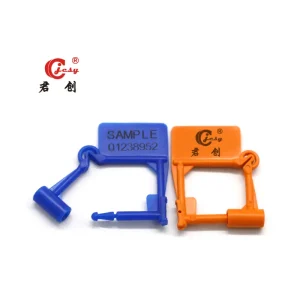
Tamper evidence is the whole point. A reliable seal leaves unmistakable signs when someone tries to defeat it: stress whitening on the plastic, a distorted lock body, or a broken locking insert that can’t be re-engaged. A seal that can be opened and closed without visible marks is a liability, not a security product.
How to Visually Inspect Padlock Seals for Defects
A consistent visual inspection catches production defects that weaken the seal long before it reaches the field. I recommend going through each seal in a sample batch under good lighting, looking for the following points.
| Defect Type | What to Look For | Why It Matters |
|---|---|---|
| Flash on parting line | Excess plastic along the seam where mold halves meet | Creates a weak point that cracks under lateral force |
| Sink marks | Localized depressions on the surface, often around thick sections | Indicates improper cooling and internal voids in the material |
| Incomplete serial number | Faded, smeared, or partially missing laser marking | Breaks traceability; a critical security feature for supply chain audits |
| Discoloration or streaks | Uneven color distribution, especially near the gate | Suggests degraded regrind material or poor mixing, reducing mechanical properties |
| Burrs on locking tab | Rough edges on the part that inserts into the lock body | Can prevent full engagement, leaving the seal partially locked |
| Gate vestige | Raised nub from the injection point that sits above the surrounding surface | If it protrudes too much, it can catch and snap off during handling |
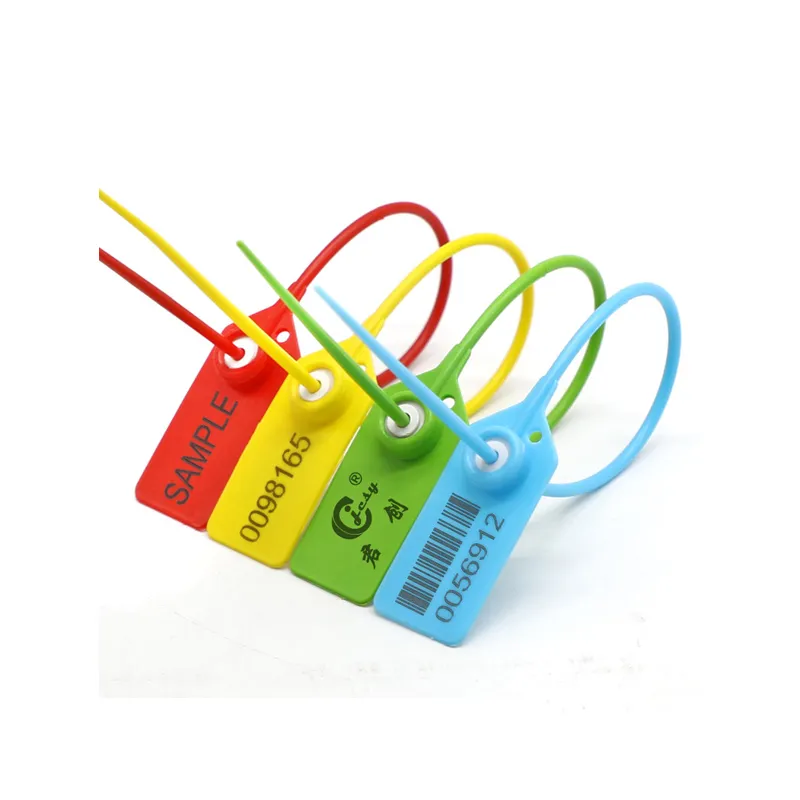
Beyond the list, check the barcode or serial number legibility. A blurry laser mark may pass a quick check but will fail scanners at a busy distribution center. Run a finger over the marking; if it feels recessed but uneven, the laser power was inconsistent, and the mark may not survive outdoor exposure.
How to Test the Locking Mechanism and Tamper Evidence
Visual checks uncover surface issues, but a padlock seal must also perform under force. I suggest two simple tests that don’t require a lab.
First, the locking feel test. Insert the locking tab into the body and listen for the click. It should be sharp and immediate, with no spongy resistance or need to wiggle the tab. If it takes more than one try, the jaw alignment is off. After locking, pull back on the tab with reasonable hand force—not a full-body tug, but enough to simulate vibration or a curious handler. The seal should hold. If the tab slides back out even a few millimeters, the locking insert isn’t biting deep enough.
Second, the tamper test. Once the seal is locked, try to rotate the tab side to side. A slight flex is normal, but any visible separation between the tab and the housing means the lock body is spreading under torsion. That gap is a entry point for a thin tool. Then destroy the seal by breaking it open as intended—pulling the tab until it snaps or cutting the housing. Note how much force it took and whether the failure was clean. If the plastic tears apart in a ragged way without much resistance, the material is either too brittle or the molding introduced stress concentrations.
These tests won’t replicate a certified tensile test, but they expose manufacturing variation that a spec sheet can’t hide. If you notice a wide difference between two seals from the same batch, the supplier’s process control needs a closer look.
What Factory Quality Control Indicators Should You Look For
The difference between a padlock seal that lasts and one that fails usually traces back to the production floor. As a manufacturer, we track several process points that buyers can ask about even if they never visit the factory.
Injection mold maintenance is near the top of the list. Molds with worn cores or clogged cooling channels produce inconsistent wall thickness, which you see as sink marks or warped lock bodies. A supplier that runs molds beyond their maintenance cycle will ship seals that pass a quick visual but fail under load.
Raw material handling matters just as much. Polypropylene absorbs moisture from the air, and if it isn’t dried properly before molding, the trapped moisture turns to steam and creates micro-voids inside the part. On the outside the seal looks fine; inside, it’s a honeycomb of weak spots. We run moisture analysis on incoming resin and document the results for every production batch.
Ask the supplier how they sample each batch for dimensional checks and locking function. In our operation, we pull samples at intervals during the run and test insertion force, pullout resistance, and tamper evidence. If a batch starts drifting, we stop and adjust. A manufacturer that can’t show you those records, or that only tests at final sorting, is reacting to problems instead of preventing them.
You might also ask whether the supplier performs environmental conditioning tests. A padlock seal that functions perfectly at room temperature may become brittle at -20°C or soften at 50°C. We expose samples to thermal cycling as part of periodic validation, especially for clients with cold chain or desert freight routes. While not every procurement requires extreme-condition data, knowing the supplier can provide it gives you an extra layer of confidence.
What Questions Should You Ask Your Padlock Seal Supplier
Procurement teams often ask about price and lead time first, but a few targeted questions about quality will separate capable manufacturers from middlemen. Here are the ones I recommend adding to your supplier questionnaire.
Do you compound your own plastic or buy pre-compounded resin? Suppliers that compound in-house have more control over additive loading, including UV stabilizers and impact modifiers. Pre-compounded material isn’t automatically bad, but the supplier should be able to certify the formulation and batch consistency.
Can you provide batch-specific inspection reports? A generic certificate of compliance isn’t enough. Ask for the actual dimensional checks, locking force measurements, and visual inspection summaries for the batch you’re considering. A factory with a disciplined QC department will produce these as a matter of routine.
How do you handle mold changeovers and first-article inspection? Every time a mold goes back into the press after maintenance or a color change, the first shots need thorough checking. A supplier that skips or rushes this step risks sending out seals with dimensional drift—a few tenths of a millimeter off in the lock body is enough to cause insertion failures.
These questions go beyond the typical spec sheet. A supplier that answers them clearly is demonstrating that quality is built into the process, not sorted out at the end. For those managing high-volume or high-risk cargo routes, that kind of transparency directly reduces the chance of a seal failure in transit.
What Are the Most Common Padlock Seal Inspection Mistakes
Even with a checklist, it’s easy to miss the real risks if you focus on the wrong things. One common mistake is treating every seal type the same. A padlock seal used on a warehouse cart experiences different stresses than one securing a container door that will be lifted by crane. The inspection intensity should scale with the risk, but the basic checks remain consistent.
Another mistake is ignoring material aging. Seals stored in a hot warehouse for months before use can degrade, especially if the plastic isn’t UV-stabilized. A visual check on the day of shipment won’t catch embrittlement that shows up a week later. I’ve seen seals that passed incoming inspection but shattered during the first cold night in transit because the storage conditions weakened the polymer chain.
Relying only on the locking click is another trap. A seal that locks tightly on the bench may still fail under a twisting load if the locking jaw has poor lateral grip. That’s why the tamper test includes rotation—it reveals a failure mode that a straight pull won’t.
Lastly, assuming that a certificate equals quality. A piece of paper won’t compensate for poor mold maintenance or bad material. Use documentation as a starting point, but verify with physical samples from the actual production batch you plan to order. If the manufacturer can’t or won’t send random production samples, treat that as a red flag. For more on broad security seal pitfalls, our article on common security seal mistakes explains how these oversights lead to real-world failures.
Securing Your Supply Chain with Consistent Padlock Seal Inspection
A padlock seal that fails during transit doesn’t just make a logistics team look bad—it opens the door to cargo theft and compliance issues that cost far more than the seal itself. Developing an inspection routine that covers visual details, functional testing, and supplier process transparency turns seal procurement from a commodity buy into a supply chain safeguard.
Before you place your next order, ask your supplier for production samples from an active batch and run through the tests described here. Better yet, discuss your specific route conditions with the manufacturer so they can recommend the right material grade and locking design. At Shandong Junchuang Lock, we regularly work with importers and logistics operators to match seal specifications to real operating environments, from tropical ports to high-altitude rail lines.
If you need padlock seal samples to evaluate quality firsthand, send your part number and transportation conditions to [email protected]. You can also reach us by phone or WhatsApp at +86 13853189290. We’ll arrange samples and walk you through the inspection criteria that matter most for your cargo.
Common Questions on Padlock Seal Inspection
How often should padlock seals be inspected?
Inspect every seal before application, not just spot-check a batch. A quick visual scan for cracks, flash, and serial number legibility takes seconds. For high-security cargo or long-haul routes, add a functional locking test on a small random sample from each case. If seals have been in storage for more than six months, especially in unconditioned warehouses, increase the inspection rate because material properties can shift.
Can a padlock seal be reused after inspection?
No. Once the locking tab is inserted, the seal is permanently engaged and must be destroyed to remove it. Attempting to unlock and re-lock a padlock seal damages the internal mechanism and eliminates tamper evidence—the whole purpose of the product. For applications that need temporary closure and reopening, an adjustable cable seal is a better match.
What is the difference between a padlock seal and a bolt seal for cargo security?
A padlock seal uses a plastic body and a snap-in locking tab, aimed at tamper evidence with moderate physical resistance. A bolt seal uses a steel locking pin and a heavy metal housing, designed for high-security container doors and ISO 17712 compliance. Padlock seals suit lower-risk cargo and internal logistics, while bolt seals provide the mechanical strength required for international container shipping. Review our plastic vs metal seals comparison for a detailed breakdown of when each makes sense.
Does ISO 17712 certification apply to padlock seals?
ISO 17712 specifies requirements for mechanical security seals used on freight containers, categorizing them as indicative, security, or high-security. Padlock seals typically fall under the “indicative” or “security” level, but most are not designed to meet the high-security strength requirements that bolt or barrier seals achieve. If your application demands ISO 17712 high-security certification, confirm with the manufacturer that the padlock seal has passed the required tensile and shear tests.
How can I get production samples to test padlock seal quality before placing a bulk order?
Contact the manufacturer directly and ask for random samples pulled from a current production batch—not hand-picked pre-production samples. Provide the part number, the expected environmental conditions, and the quantity you plan to order. A responsive manufacturer will send samples with a documented inspection report. Share your requirements with Junchuang Lock at [email protected] and we’ll arrange sample seals so you can run your own quality checks.
If you’re interested, check out these related articles:
Plastic Seal Manufacturer Selection: A Strategic Procurement Guide – Junchuang Lock
Security Seal Free Sample Request Process: A Strategic Guide – Junchuang Lock
Lead Seal vs Plastic Meter Seal: Ultimate Security Comparison – Junchuang Lock
Security Seals: Preventing Cargo Theft in Global Supply Chains – Junchuang Lock
Comprehensive Quality Inspection Checklist for Security Seals – Junchuang Lock