
High security seals for export cargo fail in predictable ways, and most failures trace back to a specification decision made before the first seal is ever fitted. Export buyers cannot afford to treat seal selection as an afterthought because customs clearance, insurance claims, and cargo integrity all depend on the seal holding under real handling conditions. I have spent over fifteen years manufacturing anti-theft seals, and the difference between a dependable shipment and a costly dispute usually comes down to three things: the seal’s mechanical strength, the quality of its numbering, and whether the factory can prove what it shipped.
What Do High Security Seals for Export Cargo Need to Do?
A high security seal is not a replacement for a mechanical lock. It is a control device that leaves visible proof of interference. In export cargo movement, that single function has to hold across crane lifts, truck vibration, rail coupling impacts, and rough yard handling.
Shipment integrity depends on three interacting properties. The seal has to hold under mechanical stress. If it snaps in transit because the pin was too soft or the bushing was out of tolerance, the number recorded at the port of loading no longer matches the number at the consignee’s receiving dock, and that mismatch opens the same dispute as a cut seal. The seal also has to resist deliberate removal, because thieves target the easiest point, and a weak seal body is often that point. Visible failure is the final requirement: a removed seal that can be reassembled without marks gives the receiver no way to know the cargo was opened.
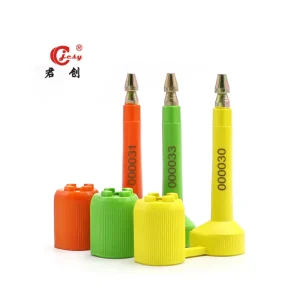
At our production line, we inspect the locking geometry before surface treatment, not after. A small burr in the locking drum can pass a bench check and then fail in the field, and that is exactly the kind of defect that only shows up after a container has bounced through three handling modes.
Which Standards Apply to Export Cargo Seals?
Most export buyers meet ISO 17712 early because international customs and border protection programs reference it. The current edition, ISO 17712:2013, separates seals into three groups: indicative seals, security seals, and high security seals. High security seals must clear defined mechanical resistance tests, and the manufacturer has to document the results for the exact model under consideration.
The standard is not a single certificate. A factory can mark a seal as ISO 17712, but the buyer should ask for the test file that matches the model, the material, and the production batch. The testing covers tensile load, shear load, bending, and impact. In practice, a high security bolt seal should absorb rough cargo door movement without the locking barrel pulling free or the pin shearing below its rated figure.
One reason for that strictness is supply chain accountability. Export programs under C-TPAT and equivalent security frameworks commonly expect high security seals on cross border containers. When our team supplies ISO 17712 high security seals, we keep the raw test data tied to the lot number, not only a pass or fail summary.
How Do Bolt Seals and Cable Seals Compare for Export Cargo?
The choice between a bolt seal and a cable seal is not a simple matter of one being safer. It depends on how the container gets handled, how often it gets reopened, and what physical shape the latching point is.
| Factor | Bolt Seal | Cable Seal |
|---|---|---|
| Typical strength | High tensile and shear resistance; rigid body | Strong but flexible; diameter determines pull resistance |
| Best use | Ocean container doors, cross border long haul moves | Tanker valves, rail cars, irregular latching points |
| Inspection | One-piece removal with a cutter; obvious destruction | Must be cut; cable fraying can expose attempted attack |
| Numbering | Engraved on pin and body for a double record | Printed and often repeated along the cable length |
| Cost per unit | Higher | Generally lower |
If your program involves both ocean containers and tank trailers or rail equipment, the specification becomes more complex than ordering one part number. A mixed fleet often has at least two latching geometries, and the buyer who specs a single seal across all of them accepts a weak point somewhere. If you are working through that decision now, send your latching points and transport modes to [email protected] and we can match the seal to each mode before the order is fixed.
When a Bolt Seal Makes More Sense
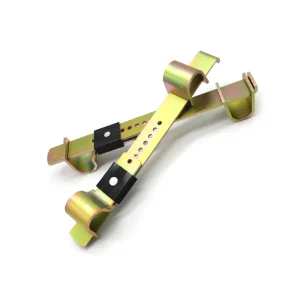
Bolt seals are the default for export container doors because the rigid pin and bushing resist prying without the flexibility that can hide partial cutting. Buyers moving high value cargo by ocean freight should begin with a shipping container bolt seal unless the door geometry prevents it.
When a Cable Seal Is the Better Fit
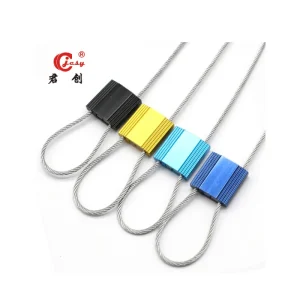
Cable seals work where the application has to wrap around a valve wheel, a tanker hatch, or a rail hasp that moves in transit. The flexible cable follows the part and carries the inspection load, but the buyer has to specify the diameter and pull strength instead of assuming any cable seal is enough.
What Should Buyers Check Before Ordering High Security Seals?
A low unit price means little if the seal fails a receiving inspection after a full container load has arrived. Buyers should verify four things before releasing a purchase order.
- Locking engagement. Ask the factory to show the pin and bushing fully seated. A seal that clicks before final engagement can feel tight and still separate under load.
- Numbering durability. Rub the laser or engraved number with a fingernail. If the marking lifts or smears, it will not survive the receiving dock.
- Batch consistency. Request samples from two production runs, not a hand picked showroom sample.
- Test evidence. Match the test report to the exact model and material, not a generic catalog sheet.
Factory Evidence to Ask For
Ask for the material certificate for the pin and body, and the finished seal test certificate. A factory that runs its own tensile and shear equipment should be able to show the raw data, not only a summary line.
Sample Testing Sequence
Before committing to bulk, order raw samples and mark the inquiry with the part number and quantity. When the samples arrive, cut one seal off under controlled load, pull the next sample to its rated claim, and check the printed marking under direct sunlight. That sequence catches the failures that catalog photos miss.
How Should Export Buyers Secure a Reliable High Security Seal Supply?
Export buyers carry the mismatch risk when a seal fails. The supplier can refund the seal cost, but no supplier can recover the lost time from a customs hold, an insurance investigation, or a consignee’s refused delivery. A stronger buying position starts with a factory that holds tolerances across repeat orders and treats the seal number as a controlled record, not decoration.
At Shandong Qingyun Junchuang Lock Industrial Co., Ltd., we make high security bolt seals and cable seals with serialized marking, batch records, and in-house test data. If you are preparing an export program, send your part number or latching point, required quantity, and delivery timeline to [email protected], or call or message us on +86 13853189290. We will confirm stock, material options, and the documentation that matches your route before you commit.
What Export Buyers Ask About High Security Seals?
What is the difference between a high security seal and a regular security seal?
A high security seal must clear a higher mechanical test threshold than a regular security seal, and it is constructed so removal leaves visible damage. Regular security seals are useful tamper evident indicators, but they cannot stand up to the same pulling and cutting forces. For container doors and cross border cargo, the higher grade is normally the right starting point because the seal is the one line of evidence that survives the move.
Are all ISO 17712 seals good enough for export cargo?
The marking alone is not enough. A seal can carry an ISO 17712 reference and still be the wrong one for a shipment if the factory cannot produce test evidence for the exact model and lot. Buyers need to check the seal grade within the standard, the test report, and the marking durability. An ISO 17712 reference on a weak or poorly marked seal is a label, not a control.
How many spare seals should I keep in inventory?
It depends on the risk points in your route and how the cargo gets inspected. For a full container load, keep at least one spare seal per vehicle entry, plus additional stock for door changes, customs replacement, or a damaged seal found before departure. That buffer is far cheaper than a missed departure while a truck waits on a replacement seal.
Can I get my company name printed on high security seals?
In export programs we have supplied, custom marking is routine, but the printing is only as durable as the surface preparation and the marking method. Laser engraving and hot stamping each behave differently in salt spray and sunlight, so the artwork should be tested on the actual seal material. If your program needs custom marking, send your artwork and quantity to [email protected] and we will confirm print durability for your route.
If you’re interested, check out these related articles:
Adjustable Cable Seal Selection: Securing Global Logistics – Junchuang Lock
Selecting Ear Tag Size and Color: A Strategic Guide for Livestock – Junchuang Lock
Seal Numbering: Enhancing Supply Chain Traceability – Junchuang Lock
Metal vs Plastic Cable Ties: Selecting the Right Industrial Fastener – Junchuang Lock