
Finding a high security barrier seal manufacturer involves more than comparing product photos or price lists. In container shipping, cross-border trucking, and high-value cargo transport, the barrier seal is often the last physical line of defense before cargo moves. A manufacturer’s raw material choices, machining tolerances, and internal audit discipline directly determine whether that seal holds or becomes a liability at a customs checkpoint. After fifteen years of overseeing production lines and quality control for industrial security seals, I can say that most procurement delays and compliance rejections trace back to three factors: unclear certification evidence, inconsistent fit between locking pin and barrel, and no third-party tensile test data at the actual lot level.
Barrier Seal Security Standards and Certification
A high security barrier seal must meet ISO 17712 high security grade requirements. That standard defines the tensile strength threshold — typically above 10 kN for the complete lock body — and mandates independent testing for tamper evidence. However, a certificate alone is not enough. I have encountered shipments where the test lab report covered one production batch, but the seal lot delivered was manufactured six months later with a different zinc alloy composition. The result was a barrel deformation before the rated load was reached.
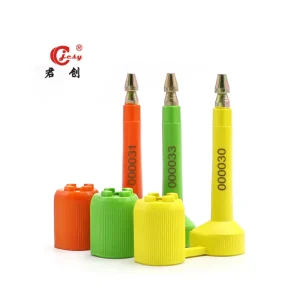
When evaluating a manufacturer, ask for the test certificate lot number and match it against the batch traceability system. ISO 17712 also requires that the seal show clear, irreversible tamper evidence upon removal. The barrier seal’s design achieves this because the locking pin snaps into a hardened steel ring inside the barrel, and any attempt to extract the pin will spread the barrel walls or fracture the pin head, leaving permanent deformation. A legitimate manufacturer will share photographic documentation of tamper attempts on their production samples, not just marketing statements.
What Is the Difference Between “High Security” and “Heavy Duty” Labels?
“Heavy duty” is a marketing term with no formal definition. I have seen seals labeled heavy duty that break at 4.5 kN. “High security” under ISO 17712 requires passing a series of laboratory tests including tensile stress, shear, bending, and impact. If a supplier cannot provide the clause references from the test standard that their product passed, treat it as a general-purpose seal regardless of the label. For cargo insurance purposes, shipping lines and insurers increasingly demand the ISO 17712:2013 high security designation, so using an unverified seal may void coverage.
Production Capabilities That Matter
Barrier seal manufacturing starts with material sourcing. The lock barrel is typically machined from steel or high-grade zinc alloy, and the pin is hardened steel. I have walked through factories where the zinc alloy ingots sat unprotected in a courtyard for weeks, leading to internal porosity that cannot be detected by visual inspection alone. A manufacturer with controlled raw material storage, humidity monitoring, and incoming material hardness testing before machining is one that understands seal reliability is built at the foundry stage, not added later.
Machining accuracy determines whether the pin locks at the correct depth and whether the locking mechanism engages fully. The tolerance between the pin and the internal locking ring should be within 0.05 mm. Tighter than that, and the pin may jam during insertion in cold weather; looser, and a thin shim tool can bypass the lock. We verify this on a coordinate measuring machine (CMM) for first articles and then use go/no-go gauges at the production line for every shift. Ask your supplier about their pin-barrel fit verification process. If they describe only a “visual check,” the batch consistency will vary widely.
How Does a Factory’s Equipment Affect Seal Reliability?
The barrier seal’s anti-spin feature — a machined groove or flat that prevents the pin from rotating once locked — requires a CNC turning center with live tooling. Factories that use manual lathes for this operation cannot hold the positional tolerance across thousands of pieces, and the resulting seal may spin freely, allowing a determined attacker to unscrew the pin. When we bring a new barrier seal model from prototype to mass production, we run a 50-piece capability study measuring pin runout and locking depth, and we require a Cpk of at least 1.33 before releasing the batch. A factory that does not understand process capability indices likely cannot guarantee consistency beyond the initial samples they send you.
Custom Barrier Seal Manufacturing Options
Importers and logistics companies often need custom laser marking, barcodes, sequential serial numbers, or company logos on the seal barrel or pin head. The marking method matters: laser engraving that penetrates the surface is more durable than inkjet printing, which can be rubbed off with fuel or solvent. I recommend specifying laser marking depth of at least 0.1 mm and then asking for a sample that has been exposed to salt spray for 48 hours to confirm legibility. Many manufacturers offer printing but default to shallow marking unless the depth is explicitly agreed upon.
Color options for the barrel coating are another customization point. If a customer in the Middle East orders red barrier seals and the coating fades to pink after two months of sun exposure, the cargo identification system breaks down. We use UV-stabilized powder coating and test color fastness with a QUV accelerated weathering chamber per ASTM G154. If color coding is critical for your operation, request the coating specification sheet and a weathering test report — do not assume “industrial grade” means UV resistant.
| Customization Feature | Material / Process | Verification Method |
|---|---|---|
| Laser serial numbering | CO2 or fiber laser, 0.1-0.2 mm depth | Sample salt spray 48h, check readability |
| Barcode or QR code | Fiber laser on flat barrel surface | Barcode scanner verification at 1 m distance |
| Color coating | UV-stabilized polyester powder | ASTM G154 QUV test, 200 hours minimum |
| Custom logo / text | Laser engraving or hot stamping | Dimensional check of logo placement tolerance ±0.5 mm |
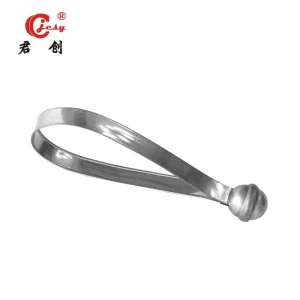
If you are importing barrier seals and want to distinguish your product from competitors, investing in the physical marking specification upfront avoids the cost of rejected shipments at the port. One client in South America had an entire container flagged because the import permit listed a specific marking pattern, but the seals arrived with a generic stamp that did not match the filed documentation. We now embed that permit review into the sample approval process before production begins.
Quality Control Systems and Factory Audits
Real quality control in barrier seal manufacturing is not a final inspection table. It is a series of in-process checks at each production step. I expect a qualified manufacturer to have documented control plans for incoming material hardness testing, in-process dimensional checks (pin diameter, barrel bore, locking ring groove depth), assembly force verification, and final tamper evidence testing on a sampling basis.
A practical factory audit can be done by video call if an on-site visit is not possible. Request to see the calibration certificates for the tensile testing machine — not the machine itself, but the calibration sticker from an accredited lab — and the actual test jig used for barrier seals. Many factories have a tensile tester but use incorrectly sized grips that slip before the seal fails, producing artificially high or low readings. Ask the operator to run a test on the spot and share the force-displacement curve. A smooth curve that ends in a sharp drop when the pin shears is a sign of a properly configured test. A curve with slip artifacts or load drop at the grip jaws indicates an unreliable test setup.
Can a Small Order Still Meet Quality Standards?
Yes, but the communication burden shifts to the buyer. For small trial orders of 500 to 1,000 pieces, the manufacturer may assign a general-purpose production line rather than a dedicated barrier seal cell. In that case, specify the acceptance quality limit (AQL) in the purchase order. For barrier seals used in container security, I recommend AQL 1.0 for critical defects (locking failure, pin fracture, illegible marking) and AQL 2.5 for minor cosmetic issues. Without a defined AQL, the factory may ship parts that pass a casual look-over but fail under load. We include a pre-shipment inspection checklist with every small batch to set clear pass/fail criteria before the goods leave the floor.
Pricing Factors and Order Planning
The cost of a high security barrier seal is driven by four variables: raw material alloy grade, machining complexity, marking requirements, and testing documentation depth. A steel barrel with a hardened steel pin and full ISO 17712 lab test will cost significantly more than a zinc alloy seal with a self-certified strength claim. When comparing quotes, isolate whether the price includes the certification testing fee, the marking setup charge, and any tooling amortization. Factories that bundle these into a single unit price make it easier to compare total landed cost; those that separate them allow more negotiation on repeat orders once the tooling fee is recovered.
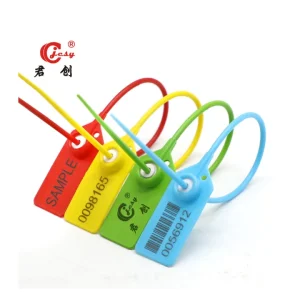
Minimum order quantities for custom barrier seals usually start at 2,000 to 5,000 pieces, though some manufacturers accept smaller batches with a setup fee. If your annual consumption is below that, ask if the factory stocks a standard barrier seal model that can be marked with your logo and serial range without a full custom tooling build. This approach allows you to test the product in your logistics chain without committing to a large inventory.
If your program involves balanced load requirements where the seal must survive vibration and shock during long-haul rail transport, it is worth confirming the dynamic fatigue performance beyond the static tensile test before finalizing your BOM. We have performed this testing for mining equipment shipments, and the failure mode in a bouncy rail car is often different from a steady pull in the lab.
Common Questions About High Security Barrier Seal Sourcing
Are All ISO 17712 Barrier Seals Interchangeable Between Manufacturers?
No. While ISO 17712 defines test criteria and tamper evidence requirements, it does not specify the locking mechanism design, barrel dimensions, or pin head profile. A barrier seal from one source may have a 9 mm barrel diameter with a straight pin, while another uses an 8.5 mm barrel with a stepped pin. Your container door hasp slots may accept one and jam on the other. Verify fitment with a sample before switching suppliers, even if both carry the same certification.
What Is the Most Common Quality Failure in Barrier Seals?
In our quality lab, the most frequent issue is incomplete locking pin engagement. The operator inserts the pin, hears a faint click, but the locking ring has not snapped fully into the pin groove. This seal will pass a visual tug but fail under less than half the rated load. The root cause is usually a burr on the pin groove or inconsistent ring heat treatment, both of which are preventable with in-process gauging. I recommend that buyers include a post-assembly pull test on 2% of each shipment as a receiving inspection step, using a portable force gauge set to 50% of the rated tensile strength.
How Can I Verify the Tamper Evidence Effectively?
Tamper evidence on a barrier seal must be irreversible. When the seal is removed illegally, the locking mechanism should deform such that the seal cannot be reassembled without obvious damage. The most reliable verification is destructive: try to remove the seal with hand tools (pliers, screwdrivers, pry bar) and document whether the deformation pattern matches the manufacturer’s reference photographs. If the pin can be extracted with a shim and reinserted without leaving a visible fracture, the seal is not tamper-evident regardless of its rating. Share your requirements and we can provide a written tamper resistance verification procedure for your receiving warehouse.
What Documentation Should I Receive with a Barrier Seal Shipment?
A complete shipment package for customs-secured cargo should include the ISO 17712 certificate showing the issuing lab, the test report number linking to that certificate, the batch or lot traceability number stamped on each seal, and a packing list with individual box serial ranges. Some importing countries also require a manufacturer’s declaration of conformity. I advise clients to scan and file these documents by container shipment, because if a seal is found broken at destination, the documentation trail is the first thing the insurance adjuster will request. If you need to align documentation formats with your specific customs requirements, reach out at [email protected] or call +86 13853189290.
If you’re interested, check out these related articles:
Bolt Seals for Containers: Enhancing Global Cargo Security – Junchuang Lock
Security Seals: Types, Applications, and Tamper Prevention – Junchuang Lock
Mastering Seal Strength: Metrics for Industrial Security – Junchuang Lock