
Finding a reliable metal strap seal manufacturer isn’t just about comparing unit prices. I’ve spent over fifteen years on the production floor of a security seal factory, and I’ve seen too many importers receive containers of seals that pass a visual check but fail in the field — inconsistent material hardness, buckle jaws that slip under tension, or strap surfaces that corrode before the shipment reaches its destination. This isn’t a list of supplier names; it’s the practical checklist I use when evaluating a metal strap seal production line, because an ISO certificate alone won’t guarantee a tamper-proof seal that holds up in transit.
How to Distinguish a Real Metal Strap Seal Manufacturer from a Trading Company
Many supplier websites show factory photos, but the operation behind them can be little more than a repacking room. A genuine metal strap seal manufacturer runs metal stamping presses, buckle assembly stations, and heat treatment equipment under one roof. I’ve walked into workshops where the only machines were an inkjet printer and a packing table — that setup can print a logo on finished seals, but it cannot form the strap blank or calibrate the locking mechanism.
Why a Factory Audit Is the Only Way to Be Sure
A video call showing the production floor in real time reveals more than a prepared presentation. Look for the continuous stamping line: if the metal strap blanks are being cut and formed on-site, you’ll hear the rhythmic thud of a mechanical press. If the room is quiet except for a printer, you’re looking at a reseller.
What Documents Prove Direct Manufacturing
Ask for the business license that lists “metal security seal manufacturing” as a registered activity, not just “wholesale” or “import-export.” A legitimate factory will also hold a safety production permit for metalworking and, for export, an ISO 17712 certification that covers the specific strap seal model, not just a generic company certificate.
Common Misrepresentations to Watch Out For
“Own factory” claims often mean a pre-arranged visit to a cooperator’s workshop. Watch whether the factory tour host can answer process questions — a real production manager knows the stamping die life, the buckle tolerance, and the heat treatment cycle. A middleman pivots back to price.
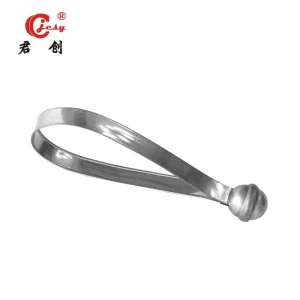
What Manufacturing Processes Determine a Metal Strap Seal’s Reliability?
You don’t need to be a metallurgist to read a production floor. But you do need to know which processes separate a security seal from a simple metal strap. The table below groups the core operations and what I check during a factory visit.
| Production Step | What to Observe | Why It Matters for Import Quality |
|---|---|---|
| Metal strip slitting and stamping | Consistent width, clean cut edge, no burrs along the strap body | Burrs become stress points; they initiate cracks during tensioning |
| Buckle jaw forming and welding | Uniform jaw profile, no cold joints or visible undercut at the weld | A weak buckle weld lets the strap pull through under moderate force — defeats tamper evidence |
| Heat treatment and surface finishing | Controlled furnace temperature logs, even bluing or zinc coating without flaking | Controls strap hardness and corrosion resistance; inconsistent heat treatment leads to brittle or overly soft straps |
Metal Stamping Precision and Material Hardness
A stamping die that’s past its service life produces strap edges with small tears. Those tears don’t look dramatic, but I’ve tested straps where the crack propagated from a 0.2 mm stamping burr under only 60% of the rated tensile load. The factory should change dies on a preventive schedule and record it.
Buckle Welding Quality: Why It Can’t Be Skimped
The locking buckle is a small component, but it takes the entire sealing load. In high-speed production, poorly set welding parameters produce joints that look solid but snap during a twist test. Ask whether the factory performs a routine pull-test on buckle welds from each batch — not just a final-inspection check.
How Heat Treatment Affects Anti-Corrosion Performance
Cheap strap seals skip post-stamping heat treatment to save cost, leaving residual internal stress. In a humid container environment, those stressed areas corrode first. A factory that can show its heat treatment cycle sheet and salt-spray test records is one that understands long-haul shipping conditions.
How to Verify Quality Control in a Metal Strap Seal Factory
Certificates can be photocopied. In-process checks cannot. I look for three inspection gates: incoming strip material hardness verification, in-line buckle crimp dimension checks every two hours, and a final batch pull-test with documented pass-fail criteria.
Key In-Process Inspection Points
At a minimum, the production line should have a go/no-go gauge station next to the buckle assembly machine. Operators check the jaw gap at set intervals and log the result. If the log sheet is missing or the gauge looks unused, I treat it as a red flag — the factory is shipping product without knowing whether the lock will hold.
Batch Testing and ISO 17712 Compliance
ISO 17712 is a security seal standard, not a manufacturing quality standard. A test report from an accredited lab proves that the sample passed; it doesn’t prove that your production batch matches the sample. The factory should perform in-house tests that mirror the certification procedure on every lot number.
What a Good Rejection Rate Looks Like
Zero-defect promises in metal stamping are unrealistic. A transparent factory will admit a reject level — typically under 0.5% for stamped components when the process is controlled. Higher rates mean the process isn’t stable, and those defects end up in your sealed container.
If your shipment crosses borders where customs integrity is non-negotiable, it’s worth confirming the factory’s actual batch-testing procedure before you finalize your order. Reach out at [email protected]; I’m used to walking procurement teams through what we check on our own production runs.
Custom Metal Strap Seal Manufacturing: What’s Possible?
Beyond the standard flat strap with a fixed-eye buckle, a factory with in-house tooling can produce custom strap lengths, printed serial numbers, and company logos. This isn’t a downstream decoration step — the marking must be durable enough to survive salt spray and handling abrasion.
Laser Printing and Serial Numbering
Laser engraving on the strap surface provides permanent, legible numbers that can’t be wiped off. For container seals, we laser-mark both the strap and the buckle to give customs a quick visual match. If you need sequential barcoding, confirm the printer has an automated conveyor rather than a hand-fed jig — throughput matters for large volumes.
Color Coding and Material Options
Standard metal strap seals use cold-rolled steel with a blue or zinc-passivated finish. For high-corrosion environments, some importers specify 304 stainless steel strapping. A manufacturer that can offer stainless needs a separate slitting line to avoid cross-contamination; ask about that directly.
Bulk Metal Strap Seal Orders: What Determines Pricing and MOQ?
Factory-direct pricing follows the raw material weight plus processing cost, not market comparisons. A 0.8 mm thick, 400 mm long steel strap with a standard buckle might cost twice as little as a 1.2 mm thick, 600 mm stainless version, because the blank weight and the stamping die wear differ sharply.
- Material grade: Cold-rolled steel Q195 / SPCC is the economical baseline; stainless 304 adds 60-80% to material cost.
- Strap dimensions: Length over 500 mm and width above 12 mm requires a larger stamping die and sometimes a slower press speed.
- Surface treatment: Zinc plating is standard; nickel or Dacromet coating for marine cargo pushes the cost higher but extends service life.
Most factories set MOQ around 10,000 pieces for a standard size, partly because the stamping die setup takes time. At Shandong Junchuang, we’ve accommodated 5,000-piece trial orders when the size matches an existing die. For a firm price per piece, share your strap length, buckle eye diameter, and target metal grade — we calculate from the strip weight and reject any guesswork.
Building a Long-Term Supply Partnership with a China Metal Strap Seal Factory
The difference between a one-time order and a supply chain asset is consistency. A factory that genuinely manages its own metal stamping, heat treatment, and assembly can reproduce your seal specs across multiple production runs without drift.
I’ve taken procurement managers through our production line in Qingyun, from strip coil receipt to finished seal packaging. When they see the same operators at the same buckle assembly stations across two visits, it settles a lot of doubts. Regular factory audits — even remote video audits — keep both sides accountable.
For a partnership to hold through shipping peaks and material price swings, the factory needs to maintain buffer stock of your stamping dies and a safety inventory of the specified strip material. Ask directly: “If I need 30,000 seals next month, what’s your confirmed lead time and what raw material do you have on hand?” A manufacturer that answers with a specific number backed by a production schedule is one worth building a relationship with.
Metal strap seal sourcing that fails mid-transit isn’t a minor inconvenience; it creates container inspection delays, insurance claims, and cargo integrity disputes. If batch quality swings have been a headache, and you want a supplier with the in-house metal forming line that I’ve described — stamping through heat treatment — send your part number, quantity, and target material grade to [email protected] or call +86 13853189290. We’ll return a factory-direct quotation and a pre-shipment sample so you can check buckle locking and strap hardness before committing to a container-load.
Common Questions About Metal Strap Seal Sourcing
What’s the real difference between a bolt seal and a metal strap seal?
A bolt seal locks rigidly and must be cut with a bolt cutter to open the container door. A metal strap seal is a flexible tamper-evident device that can be removed with hand-cutters but leaves obvious cut marks; it also allows a customs inspector to snip the strap and reseal with a documented replacement. For cargo that requires visual inspection access during transit, the metal strap seal is more practical. In our production, we often recommend strap seals for intermodal containers that get door checks at multiple distribution points.
Can metal strap seals be printed with our own company name and sequential barcode?
Yes. Laser engraving on the strap surface provides permanent, high-contrast marking that doesn’t rub off. We can also combine a hot-stamped logo on the buckle with laser-numbered strap tails, which gives cargo surveyors two reference points. The setup requires a printing plate or laser programming file, but once the template is approved, repeat orders match exactly.
How do I independently verify that a metal strap seal factory meets ISO 17712?
Ask for the test certificate that matches the specific product model — a blanket “factory ISO certificate” doesn’t prove seal compliance. Request a sample batch and have it tested by an independent lab in your country for tensile strength and tamper-evidence. In parallel, ask the factory for its internal pull-test records linked to lot numbers. If the records don’t exist or the sample batch fails your lab test, walk away.
What is a realistic MOQ for custom-dimension metal strap seals?
Most factories start at 8,000 to 10,000 pieces to spread the die cost. If your required strap length works with an existing die, the MOQ can drop to 5,000 pieces. We’ve supplied trial quantities of 3,000 pieces when the customer only needed a different laser marking, not a new die. For a firm MOQ against your dimensions, send your target length, width, and buckle eye diameter — we check the tooling library and give you a straight answer. If a small-batch trial is possible, we’ll arrange it.
If you’re interested, check out these related articles:
Ear Tags for Cattle and Sheep: Optimizing Livestock Traceability – Junchuang Lock
Wholesale Plastic Seals for Trucking: Secure Your Fleet – Junchuang Lock
Metal vs Plastic Cable Ties: Selecting the Right Industrial Fastener – Junchuang Lock
Bulk Bolt Seal Orders MOQ and Pricing Strategies – Junchuang Lock
How to Choose High Security Bolt Seals: Key Criteria for Supply Chain Safety – Junchuang Lock