
A metal strap seal factory audit reveals more than glossy certificates; it exposes the precision of stamping dies and the consistency of locking mechanisms, two areas where production shortcuts cause most field failures. In my fifteen years overseeing seal manufacturing at Junchuang Lock, I have seen how small variations in zinc alloy composition or stamping pressure directly affect tamper evidence and seal integrity. This guide covers the practical inspection points that separate reliable suppliers from the rest, from material verification to customization controls.
What Should You Verify Before a Metal Strap Seal Factory Visit?
Before stepping onto the production floor, request the factory’s business license, ISO 9001 quality management certificate, and any product-specific certifications such as ISO 17712. A factory that hesitates to share these documents raises a red flag immediately. Review their product datasheets for metal strap seals—check if they list material grade, typically zinc alloy or steel, tensile strength, and operating temperature range. Ask for a pre-shipment sample of their standard metal strap seal. Examining the sample before arrival gives you a baseline for the locking tab’s snap engagement and the uniformity of the stamping.
What certifications should a metal strap seal manufacturer have?
At minimum, a manufacturer should hold ISO 9001 for quality management. For high-security applications, ISO 17712 certification is essential; it validates that the seal meets standardized tensile strength and tamper-evidence requirements. Some buyers also look for C-TPAT-compliant manufacturing, but that certification applies more to the supply chain program than the factory itself. During my factory evaluations, I prioritize evidence of consistent internal process control over a long list of framed certificates.
How to Inspect Metal Strap Seal Stamping and Material Quality
The stamping process defines the seal’s structural integrity. Start by asking to see the stamping dies currently in production. Worn dies produce burred edges and inconsistent dimensions, which can cause the locking tab to fail under minimal force. I have seen instances where a die with 100,000 cycles produces seals that look identical but have a 0.2 mm thinner cross-section, enough to compromise the locking strength.
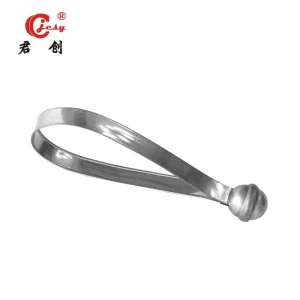
Request the material certification for the zinc alloy or steel coil being used. A reputable factory will have traceable lot numbers and chemical composition reports from their raw material supplier. Look for alloy ZAMAK 3 or equivalent for zinc seals; it offers the right balance of hardness and corrosion resistance. For steel strap seals, verify the coating thickness if galvanized, as thin plating exposes the base metal to rust in humid shipping conditions.
How do I verify the quality of the metal strap seal’s locking mechanism?
Test the locking mechanism on several samples by pulling the strap through the locking head until it engages, then apply a steady pull. A quality seal will hold firmly without the strap slipping backward. In some low-cost seals, the locking tab inside the head is stamped from thinner stock, leading to partial engagement and failure. I recommend bringing a handheld force gauge to measure the pull-through resistance on-site and comparing it against the factory’s stated specifications.
What are common defects in metal strap seals from poor stamping?
| Defect | Cause | Impact |
|---|---|---|
| Burred edges | Worn or misaligned dies | Prevents full insertion into the locking head |
| Inconsistent strap thickness | Die pressure fluctuations | Weakens tensile strength; seal may break during tensioning |
| Off-center locking hole | Stamping alignment error | Misengagement; tamper evidence compromised |
| Surface cracks | Overly hard zinc alloy | Failure under dynamic loads |
What Quality Control Systems Ensure Consistent Metal Strap Seals?
On the production line, observe whether in-line inspectors check every stamping cycle or only periodic samples. A factory committed to quality will have a dedicated QC station immediately after stamping, where operators measure critical dimensions with calipers and record the data. Ask to see the defect rate log for the past three months. I have found that factories willing to share real data—even when it includes a 0.5% rejection rate—are far more credible than those claiming zero defects.
Final inspection should include random sampling per AQL 2.5 or tighter, with documented pull tests and visual checks for tamper evidence. Confirm that the factory can provide a Certificate of Conformance with each shipment that references the lot number and test results.
How can I check the factory’s defect rate and quality consistency?
Ask for the statistical process control charts, not just the final defect percentage. A factory that tracks stamping pressure, dimension tolerance, and locking force over time demonstrates real production discipline. During one audit, I noticed that a factory’s control charts showed a gradual drift in locking tab thickness over three weeks. They had not recalibrated the die. This kind of detail is invisible if you only review a summary report.
If your application demands high tensile strength, for example, securing heavy container doors in maritime transport, verify that the factory provides detailed testing data for each batch. At Junchuang Lock, we supply test certificates with every shipment; share your specifications at [email protected] to discuss your requirements.
How to Evaluate Customization and Traceability for Metal Strap Seals
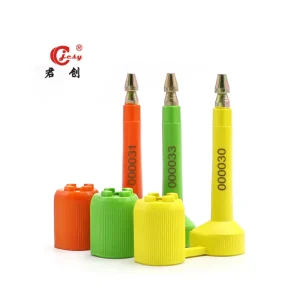
Metal strap seals often serve as a chain-of-custody tool, so customization is not just cosmetic. Confirm the factory’s printing methods: laser engraving provides permanent markings that resist abrasion, while inkjet printing can be adequate for short-term use. Ask to see examples of serial numbering sequences and barcode legibility under a scanner. A factory running automated serial number tracking ensures that no two seals carry the same number, a commitment that matters for audits and liability.
How can I ensure my metal strap seals will have unique serial numbers and traceability?
Request the factory’s serial number management procedure. A robust system uses software-controlled incremental numbering with a database that logs each production run. When I set up our serialization line, we linked the laser engraver to an ERP system that prevents duplicate numbers and generates a traceability report for each order. Ask the supplier what happens if a numbering error occurs; their answer will reveal whether the process is automated or manual.
How to Make the Final Decision After a Metal Strap Seal Factory Audit
After the visit, compile your findings into a weighted scoring sheet. Assign higher weight to stamping precision and QC documentation than to sales promises. I prioritize three data points: the stamping die condition log, the material certification traceability, and the serial number management system. A factory strong in all three rarely disappoints on delivery consistency.
Communication responsiveness during the audit stage often mirrors post-order support. If queries about tensile strength results or barcode legibility took days to answer, expect similar delays during production. Trust is built on consistent small demonstrations, not on a single impressive meeting.
What red flags should disqualify a metal strap seal factory completely?
Refusal to share stamping die maintenance logs, inability to provide material certifications, and a production floor with no visible QC instruments are immediate disqualifiers. I once inspected a factory where operators were using hand files to deburr stamped seals because the die was too worn; that factory could not guarantee any dimensional consistency. Another warning sign is the factory cannot produce a complete serialization report from a previous order. If they cannot demonstrate traceability, assume yours will not be tracked either.
Common Questions About Metal Strap Seal Factory Audits
Can I trust a factory that only provides photos and videos instead of samples?
Photos can be retouched, and videos can be staged. I have encountered cases where a sample sent by courier bore little resemblance to the product later shipped in bulk. Always request a physical pre-production sample, and if a visit is impossible, ask for a random sample drawn from current inventory and shipped directly, not specially prepared.
How long does a typical factory audit take?
A focused audit covering stamping, QC, and customization takes about four hours. Adding deeper material verification and document review can extend it to a full day. I allocate extra time to observe the stamping line during a shift change; that transition often reveals whether processes are disciplined or worker-dependent.
What if the factory doesn’t have ISO 17712 certification? Is that a deal-breaker?
Not necessarily. Some smaller factories produce mechanically sound seals but have not pursued third-party certification because of cost or limited export volume. In such cases, check if their in-house testing matches ISO 17712 requirements for tensile strength and tamper evidence. However, for cross-border shipments requiring customs compliance, ISO 17712 certification is nearly mandatory.
Does a factory’s location matter for metal strap seal quality?
Quality depends on engineering expertise and material sourcing, not geography. However, proximity to raw material suppliers and logistics hubs can affect lead times and shipping costs. Factories in Shandong, China, benefit from well-established metal stamping supply chains and efficient port access, which I have found translates into faster order fulfillment for overseas buyers. If you are sourcing metal strap seals and want to discuss how location and supply chain affect your lead times, share your delivery schedule with us at [email protected] and I will outline feasible production timelines.
Finding a factory that consistently delivers tamper-evident metal strap seals requires more than a quick visit; it demands a systematic look at stamping precision and material quality. If you need a manufacturing partner with proven production discipline, email us at [email protected] or call +86 13853189290 with your seal specifications and quantity. We will confirm material options and provide a same-week sample for your evaluation.
If you’re interested, check out these related articles:
Pull Tight Seal Manufacturer Comparison: Key Selection Factors – Junchuang Lock
Optimizing Bolt Seal Storage: A Guide to Secure Handling – Junchuang Lock
Bolt Seal OEM Manufacturing Process: A Technical Deep Dive – Junchuang Lock
Plastic Seal Manufacturing Capabilities: Ensuring Global Security – Junchuang Lock
Why Security Seals Ensure Unbroken Logistics Integrity – Junchuang Lock