
When a shipment is secured with a plastic padlock seal, the real question is not only whether it keeps the door closed. The question is whether the seal was manufactured to match the exact rigors of the route it will travel, the handling it will face, and the documentation trail it must support. Over fifteen years of producing security seals, I have seen that the difference between a seal that performs and one that creates an audit gap almost always comes down to the manufacturing decisions made before the order is placed. This article walks through the concrete manufacturing options that define a custom plastic padlock seal, from material grades to serialization methods, so that you can specify with precision rather than settle for a stock listing.
What Materials Go Into a Plastic Padlock Seal and Why They Matter
A plastic padlock seal body may look simple, but the polymer grade determines impact resistance, UV stability, and operating temperature range. I recommend buyers define these three parameters first because they set the floor for everything else.
Polypropylene is the most common body material. It offers good tensile strength, resists many chemicals, and holds up to short-term outdoor exposure. For heavy handling or high-tamper environments, we often move to ABS. ABS provides stronger rigidity and better low-temperature performance—a seal that goes brittle in a freezer container is a failure waiting to happen. If the seal will be used outdoors for months in direct sunlight, UV-resistant grades with stabilizers are mandatory. We add specific antioxidant and anti-UV additives during compounding to prevent cracking and fading, which preserves legibility of printed information and the seal’s mechanical integrity.
The locking insert inside the padlock seal is typically spring steel or stainless steel. Stainless steel adds corrosion resistance but also cost. The steel jaw configuration—two-prong or four-prong—changes the gripping force on the hasp. I have observed that four-prong designs distribute force more evenly and reduce the chance of a partial engagement that can be pried open with a tool. These details rarely appear in a product catalog but are negotiated at the specification stage. It is exactly the reason why emailing your part number and application conditions to [email protected] can save troubleshooting later.
Customizing Printing and Marking for Traceability
Every plastic padlock seal in a serious logistics operation must contribute to traceability, and that work is done by the surface. The printing method and serialization scheme are not afterthoughts.
Three main marking options exist. Laser engraving produces high-contrast text that cannot be wiped off. It is the best choice for permanent individual serial numbers and barcodes because the mark penetrates the plastic surface. Hot stamping is used for colored foil logos and batch information; it provides a crisp brand appearance but does not have the same abrasion resistance as engraving. Pad printing applies ink to the surface and is cost-effective for one-color text and sequential numbering. For most industrial users, I advise laser engraving for the core ID and hot stamping for the company logo as a combination that balances durability and brand visibility.
The serialization format is equally important. We run sequential numbering, random check digits, and barcode formats from Code 128 to QR. A nine-digit laser-engraved code with a prefix that identifies the production month and factory line is one configuration we set up frequently for logistics companies that need to reconcile thousands of seal records monthly. If your program involves multiple seal types or cross-border customs clearance, it is worth confirming that the manufacturer can deliver a numbering schema that integrates with your warehouse system before you finalize your bill of materials. Send your data format specs to [email protected] and we can confirm compatibility in advance.
Security Features That Go Beyond a Plastic Shell
A plastic padlock seal is a deterrent only if the design includes features that make tampering obvious and difficult. We engineer these into the mold and the assembly process.
The most effective feature is the anti-tamper locking mechanism. When the hasp is inserted and locked, any attempt to pull it out should cause the outer body to show stress marks or cause the locking jaw to fracture the plastic in a visible pattern. Good tooling design creates predetermined break points. Secondary features include transparent inspection windows that allow a supervisor to see whether the locking insert has been disturbed, and pilot holes that accept a small break-off tool for deliberate removal without a cutting instrument. Each of these adds a layer of verification.
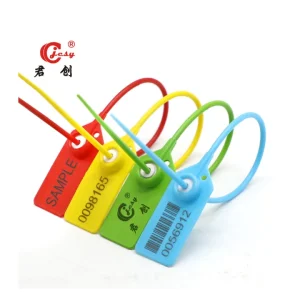
Seal strength is quantified by pull-out force. Industry practice measures the force required to separate the locked hasp from the body. A standard plastic padlock seal ranges from 18 kg to over 45 kg. I can tell you from production records that the difference between 20 and 40 kg often comes down to the steel jaw material and the thickness of the locking tab inside the body. Specifying a test protocol—such as requiring a minimum 25 kg pull force tested on every production lot—is a step that separates a credible supplier from a low-cost vendor.
Evaluating a Manufacturer’s Customization Process
When you approach a factory for custom plastic padlock seals, the conversation should move quickly from “what is your price” to “show me your mold preparation and sampling workflow.” This is the stage where partnership quality emerges.
A capable manufacturer will have in-house tooling to create new molds or modify existing ones for unique shapes, color, and logo recesses. The lead time for a new mold typically ranges from 10 to 18 days, depending on complexity, with an additional 5–7 days for sample production run. At our facility, we produce a first-article sample set in the exact material and color of the final order, not a generic off-the-shelf piece. The sample approval includes a dimensional check, pull test, and serial number accuracy verification. Because the mold shapes the seal body, reviewing sample injection points and weld lines helps anticipate weak points before mass production begins.
| Customization Area | Key Specification to Anchor | Factory Verification Step |
|---|---|---|
| Material grade | PP, ABS, UV-stabilized compound | Material test certificate per batch |
| Color | Pantone code or physical color chip | Color matching under D65 lighting |
| Marking | Laser engraving depth ≥0.1mm | Single-article legibility inspection |
| Serialization | Prefix+sequential, barcode symbology | Full lot sequence check before shipment |
Bulk orders often include additional handling steps like assembly of a wire hasp, inner packing with serialized labels, and outer carton labels with barcodes. Confirm whether these are done by the seal manufacturer or handed off to a third party. Integrated production under one roof reduces communication errors and lets you trace a quality issue back to a single work order, which is why our supply partners value direct factory cooperation.
Quality Control and Lot Traceability
After the specifications are agreed, the only thing that protects the buyer is the factory’s quality control discipline. Custom seals fail not because the design is wrong but because a production lot drifts out of tolerance and nobody catches it.
We run inline inspections at three stages: raw material incoming check, first-off inspection at the molding machine after setup, and hourly patrol inspections during the run. The patrol inspection includes pull-force testing on a random sample, dimensional measurement of critical locking features, and printing quality. A final random sampling before packing checks that serial number barcodes scan correctly and that there are no missing numbers. Documentation matters as much as measurement. Every inspection record is tied to the lot number printed on the seal carton.
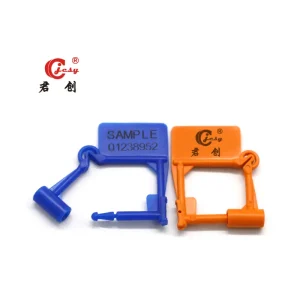
If you are qualifying a new manufacturer, I suggest requesting a small pre-production lot and asking for the associated QC sheets. A factory that cannot produce both a good sample and its supporting data will not produce consistent bulk deliveries. You can reach our quality team at +86 13853189290 to discuss the specific documentation package your program requires.
Managing Seal Procurement from Specification to Delivery
Custom seals intersect four cost drivers: material, mold investment, printing complexity, and order volume. I will not give generic pricing here because the spread is too wide—an entry-level PP seal with simple hot stamp numbering in a 100,000-unit order will cost far less per piece than an UV-stabilized ABS seal with laser-engraved QR codes in a 5,000-unit run. What I will say is that the mold cost amortizes quickly once the design is locked and the same mold is used for repeat orders. We maintain customer molds at no extra charge for the life of the partnership, which means year-over-year unit cost drops as mold investment is recovered.
Lead time for repeat orders of custom seals typically runs 15–25 working days from drawing approval to shipment, depending on marking complexity and volume. Working directly with the factory removes a layer of markup and allows real-time production updates via WhatsApp or email. If you are unsure whether your current design can be streamlined without sacrificing security, sharing your drawing or specification sheet with [email protected] often reveals an option that reduces per-unit cost while maintaining the required pull strength and marking clarity.
Common Questions About Plastic Padlock Seal Manufacturing
Can one mold produce multiple body colors or just one?
One mold can produce multiple colors because the color is determined by the plastic pellets fed into the injection machine, not by the mold. However, changing color during a production run requires purging the machine, so we batch production by color to maintain efficiency. For small quantities per color, the changeover time becomes a cost factor, but it is technically possible and common.
Is there a practical difference between laser and pad printing for field inspection?
Yes. Laser etching creates an indelible mark that survives solvents, abrasion, and hand contact far better than surface ink. Inspectors in humid or high-contact environments—think dock workers handling seals hundreds of times a shift—can verify a laser mark instantly without rubbing or angling. For any seal where post-use auditing matters, laser is the more secure choice even though it costs slightly more.
What is the minimum order quantity for a fully custom plastic padlock seal?
The minimum tends to be driven by the printing setup and material usage. For a new shape with a custom mold and full-color laser engraving, we usually set a minimum of 5,000 to 10,000 units to justify setup cost. For an existing mold with only serial number variation, smaller quantities around 2,000 units are practical. It depends on the print method: hot stamp and pad print have lower setup thresholds than laser.
How can I test a plastic padlock seal’s performance before committing to a large order?
Request a pre-production sample lot and specify the test criteria. A proper sample test will pull the seal to failure on a force gauge, cycle it through temperature extremes if relevant, and check legibility after simulated handling. We send samples with a dimensional report and pull test data so that the evaluation is data-driven, not visual. Few things build confidence faster than testing a seal to destruction and seeing where it fails. Share your requirements through [email protected] and we will prepare samples that match your application conditions precisely.
If you’re interested, check out these related articles:
High-Security Seals: ISO 17712 Compliance & Tamper-Evident Design – Junchuang Lock
Security Seal Pricing Guide: Unveiling Factors Affecting Your Investment – Junchuang Lock
Cable Seal Manufacturer Certifications: Your Guide to Compliance – Junchuang Lock
Cable Seal Technology: Understanding Its Function and Security – Junchuang Lock