
Barrier seals are among the most demanding security seal products to produce, because they combine high-tensile metal locking mechanisms with precisely molded housings that must withstand deliberate tampering attempts. This article walks through the core manufacturing stages that turn raw materials into finished custom barrier seals, from material preparation and precision forming to marking, assembly, and final testing. I base this on production floor experience at Shandong Junchuang Lock Industrial Co., Ltd., where we manufacture barrier seals for logistics providers, customs agencies, and security-sensitive supply chains.
How Custom Barrier Seal Manufacturing Begins
Barrier seal production starts with material verification. The outer housing is typically injection-molded from ABS or polypropylene, chosen for impact resistance and dimensional stability. We require incoming resin batches to arrive with mill certificates showing melt flow index and tensile modulus, because slight formulation shifts can change how the locking tabs snap into place. For the internal locking insert — the metal component that grips the hasp — cold-rolled steel strip is the standard choice. Our incoming inspection checks strip thickness to a tolerance of ±0.03 mm and hardness to HRB 65-72, which directly controls whether the finished seal can meet the ISO 17712 shear test requirements.
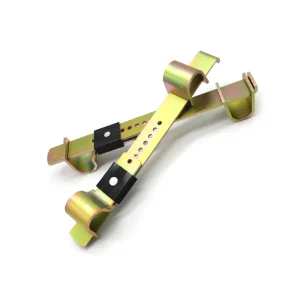
After material approval, the steel strip moves to a progressive stamping line. A single multi-station die cuts, forms, and bends the locking tabs into their final geometry in one continuous feed. This is the step where small tool wear accumulates fastest, and a dulling punch edge can leave a burr that prevents the lock from fully engaging. We schedule die maintenance every 80,000 cycles and verify tab dimensions on a sampling basis throughout the shift, not just at end-of-run inspection, because a mid-batch drift can produce thousands of seals that feel tight but fail under load.
Injection Molding the Housing for Dimensional Consistency
The barrier seal housing requires a multi-cavity mold with tight shutoffs, because the locking insert must seat at a precise depth and angle. Our molding process uses a cavity pressure sensor that transfers to holding pressure at a set switchover point, rather than relying on injection time alone. This matters for barrier seals: if the holding phase ends too early, the housing can shrink unevenly and shift the insert pocket by a fraction of a millimeter, which later prevents the hasp from inserting smoothly.
We keep mold temperature at 50-60°C using a thermolator, not just tower water, to avoid cold-slug issues at the gate that create weak points near the locking throat. After ejection, operators perform a quick visual check for short shots, flash, or sink marks. Any cavity that produces two consecutive non-conforming parts is shut off and flagged for a mold shop review before the run continues. For custom barrier seals with client-specified colors or UV-stabilized compounds, we run a full purge and short-shot trial before switching materials, so that color contamination or additive carryover does not compromise a batch.
If your application involves long-term outdoor exposure in high-UV environments, the resin grade matters significantly. Standard ABS can embrittle after a few years of direct sunlight. We can switch to ASA or UV-stabilized polycarbonate blends, but this must be specified before tooling is cut because shrinkage rates differ. Reach out at [email protected] to confirm which material matches your deployment environment.
The Locking Insert Assembly and Function Check
Once the housing and stamped metal insert are QC-cleared, they meet at the assembly station. Insertion is a press-fit operation with a controlled insertion depth stop. A simple but effective check: every assembled seal passes through a go/no-go gauge that verifies the gap between the insert’s locking tabs and the housing entry slot. If the gap is too wide, the seal may accept a thinner hasp than intended. If too narrow, the hasp will bind.
After gauge check, we perform a function test on a sampling basis using a mechanical fixture that pushes a test hasp into the seal at a defined speed and measures insertion force and locking “click” feedback. This catches the most common assembly defect: a metal insert that was not fully seated during press-fit and moves backward on first insertion, creating a seal that appears locked but can be pulled apart with less than 50% of rated force. For critical orders where the seal will be used on ISO containers, we increase the function test sampling rate to cover the entire batch, not random samples.
Custom Marking and Serialization Methods
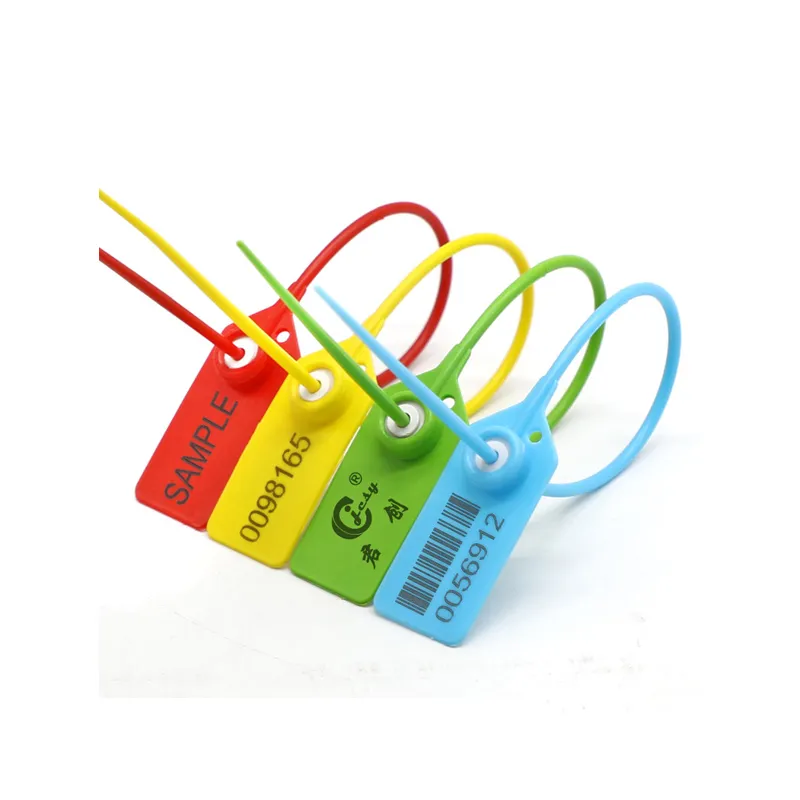
Barrier seals carry unique identifiers for traceability. The marking method depends on volume, material, and durability requirements. For polypropylene housings in medium to high volumes, hot stamping foil is often the most cost-effective method, giving a clean, permanent impression that does not add thickness. Laser marking works well for darker materials and for clients who need variable data like sequential barcodes or QR codes that change with every seal.
We handle serial number logic at the factory level. Clients can provide their own number range or let us generate a sequence with a prefix code that identifies the end user, warehouse, or shipment lane. A common request is dual marking: the seal body carries a large human-readable number, while the locking head or side edge carries the same code in a smaller font as a backup if the primary face gets scuffed during transit. This takes extra tooling for the stamping fixture, but in my experience, the redundancy pays for itself the first time a logistics team needs to reconcile a partially damaged seal record.
Quality Testing That Goes Beyond Visual Inspection
Visual checks catch the obvious problems, but barrier seal reliability depends on mechanical testing that replicates real-world attack methods. Our in-house testing includes three mandatory procedures for every production batch, not just type-approval lots.
First, pull-apart testing on a universal testing machine. We mount a sealed hasp assembly and pull at 50 mm/min until failure or until the force exceeds the rated specification threshold and we hold for 10 seconds. The pass criterion is not just peak force — we also check whether the failure mode is ductile fracture of the locking insert or brittle snap of the housing, because the latter suggests a molding defect that may not show up in visual inspection.
Second, impact testing simulates rough handling during container loading. A 2 kg steel weight is dropped from 1.5 meters onto a clamped seal assembly. The seal must remain functional after impact — no cracking, no loosening of the insert. We’ve seen seals from some suppliers pass static pull tests but shatter under this drop because the polymer lacks sufficient impact modifier. That gap only becomes visible at the destination port, when a container seal is already broken and cargo insurance claims begin.
Third, temperature cycling for seals destined for climate-variable routes. Sealed assemblies go from -20°C to +60°C over six cycles, with a function test at each temperature extreme. Cold embrittlement is the biggest risk: a seal that locks firmly at room temperature can become brittle at -20°C and crack when the container door flexes during ocean transit.
If your program involves multi-modal shipping through extreme climates, it is worth confirming that the seal has been cycled to your expected minimum temperature before you finalize the specification.
Sourcing Custom Barrier Seals That Match Your Security Requirements
When procurement teams evaluate barrier seal manufacturers, the conversation often starts with price per unit, but the real cost difference shows up in consistency and documentation. A manufacturer that can provide batch-level tensile test reports, material certificates, and serial number audit logs gives you the paperwork chain you need when a seal integrity dispute happens — and it will happen eventually.
At our factory in Shandong Qingyun County, we keep a retained sample of every production lot for 12 months, so if a question comes up about a specific batch shipped six months ago, we can pull the physical sample and re-test. For clients who require third-party ISO 17712 testing, we coordinate with accredited labs and handle the sample submission and document chain, rather than handing off the responsibility. This matters because lab lead times can stretch to four weeks during peak season, and a delay in certification can hold up a vessel.
Send your part number, quantity, and any special marking or testing requirements to [email protected] or reach us on WhatsApp at +86 13853189290. We’ll confirm production feasibility, lead time, and provide a retained sample for your internal approval before the batch run.
Common Questions About Barrier Seal Manufacturing
How long does a custom barrier seal production run take?
Typical lead time for a new custom barrier seal with existing tooling is 15-25 working days, depending on order quantity and marking complexity. If new injection molds are required, add 20-30 working days for mold design, steel cutting, and trial sampling. Rush orders are possible when material stock and machine capacity align, but I always recommend building a 10-day buffer into import planning because ocean freight consolidation adds unpredictable windows.
Are barrier seals always ISO 17712 compliant?
Not automatically. ISO 17712 specifies physical strength thresholds, tamper evidence characteristics, and marking requirements. A seal must pass an accredited lab test to carry the “H” high-security classification. When you request ISO 17712 compliance, confirm whether the manufacturer is providing a current lab certificate for the exact model and material combination you are buying — not just a blanket company certification. I’ve seen cases where a certificate dated three years ago was still being referenced for a seal whose design had changed since then.
Can barrier seals be reordered with the same serial number sequence?
Yes, serial number continuity is a standard request for ongoing supply agreements. We record the last serial number shipped per client and pick up from the next digit on the following order. For high-volume programs, we can split a single number range across multiple shipments so that warehouse teams never receive duplicate numbers within a calendar year. Confirm this with your order specification, because not all factories track serial ranges across orders unless explicitly instructed.
What is the minimum order quantity for custom barrier seals?
For injection-molded custom barrier seals, the minimum order is typically 5,000 to 10,000 pieces, driven by the setup cost of the hot stamping or laser marking fixtures and the purge volume between material changes. Smaller quantities are sometimes possible if the seal design uses existing standard housings and only the marking changes, but the unit price increases because the fixed costs amortize over fewer pieces. Share your requirements and we can evaluate whether standard tooling can accommodate a lower initial volume.
If you’re interested, check out these related articles:
Tamper Evident Seals: Safeguarding Assets and Supply Chain Integrity – Junchuang Lock
Security Seals: Preventing Cargo Theft in Global Supply Chains – Junchuang Lock
How to Identify Tampered Security Seals: A Professional Guide – Junchuang Lock