
When you purchase barrier seals for cross-border cargo, the last thing you want is a seal that fails to lock correctly or breaks under routine handling. Barrier seal factory quality control is not a box-checking exercise at the end of production; it is a layer-by-layer verification system that starts with raw materials and continues through final packaging. Drawing from more than fifteen years of manufacturing experience at Shandong Junchuang Lock Industry Co., Ltd., I can tell you that the difference between a seal that performs on a container door and one that creates a liability comes down to inspection discipline on the factory floor. This walkthrough covers the key QC steps we use and what purchasing professionals should look for when evaluating a supplier’s process.
What Does Quality Control Involve for Barrier Seals?
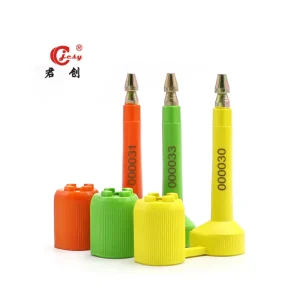
Quality control for barrier seals encompasses every physical attribute that affects tamper evidence and mechanical reliability. A complete program addresses dimensional accuracy of the locking pin and body, material hardness of the steel locking ring, pull-out force of the assembled unit, and clarity of the laser-marked serial numbers. In high-volume production, sampling plans follow AQL standards where we pull units from each batch for destructive and non-destructive testing. The goal is to confirm that no production drift compromises the seal’s ability to resist forced entry or reveal tampering. If a single parameter shifts outside tolerance, the entire batch is placed on hold until corrective action is verified. This is the kind of rigor that separates a dedicated factory from a trading company that only inspects at shipment.
How Are Materials Inspected in Barrier Seal Production?
Material inspection begins before a single component is formed. For barrier seals, the steel pin and locking ring are the hardest-working parts, so we test incoming steel wire coils for tensile strength and surface defects using micrometer gauges and spring-testing machines. The polycarbonate or ABS bodies go through impact and heat deflection checks to verify they will not crack during installation in cold weather or warp in direct sunlight on a container ship. Lot traceability is built in; every coil of steel and batch of plastic pellets receives a code that follows it through extrusion, molding, and assembly. If a later failure occurs during destructive testing, we can isolate affected units immediately. In our factory, any material that fails its arrival inspection is returned to the supplier, no exceptions.
How Is Assembly and Locking Tested for Barrier Seals?
After molding and metal forming, the barrier seal reaches the assembly line where the pin is inserted into the body and the locking ring engages. This is where production speed can create quality risks if testing is only visual. We use fixture-mounted force gauges to measure insertion force and pull-out resistance on randomly selected units every hour. The acceptable range is narrow; a pin that inserts too easily may be undersized, and excessive pull-out force suggests binding that could cause field failure. Locking ring seating is verified with a go/no-go gauge to ensure full engagement. I have personally seen production batches where tooling wear caused pin diameter to drop by less than 0.1 mm, which was enough to reduce pull-out force below the required threshold. Without in-line testing, those units would have shipped.
| QC Test | What It Checks | Typical Equipment Used |
|---|---|---|
| Tensile strength | Maximum force before pin pulls out or ring fails | Universal testing machine |
| Shear resistance | Resistance to lateral cutting force on the locking ring | Shear fixture |
| Impact test | Body integrity after a controlled drop | Drop tower or pendulum |
| Locking cycle test | Consistency of insertion force over repeated uses | Force gauge with fixture |
| Temperature cycling | Seal performance after hot/cold exposure | Environmental chamber |
What Final Inspections and Documentation Are Performed for Barrier Seals?
Before packing, every barrier seal receives a 100% visual inspection for surface defects, clarity of laser marking, and missing components. We then pull a final statistical sample for the complete battery of tests listed above and record results in a batch inspection report. Each report includes the material lot codes, production date, operator ID, test values, and pass/fail status. When a customer requests it, we provide an electronic copy of that report along with the shipment. Documentation should not be an afterthought; it is the record that proves a factory stood behind its process. If a prospective supplier hesitates to share quality records, that is a signal worth paying attention to.
How Can Buyers Verify a Factory’s QC Practices?
When I talk to importers who have had bad experiences with seal quality, the common thread is that they relied on certificates without verifying the underlying inspection system. You can flip the risk by requesting three things: a sample QC report for a recent production batch, a brief video of in-line testing on their assembly line, and a visit agenda for a factory audit that includes time on the production floor, not just the showroom. At Junchuang, we welcome these requests because they demonstrate a buyer who takes cargo security seriously. Factories that invite scrutiny are the ones that have disciplined processes; those that deflect are often masking inconsistency. Low-pressure inquiry: If your program involves high-value or regulatory-controlled cargo, it is worth confirming barrier seal test data before finalizing your procurement list.
Common Questions About Barrier Seal Factory Quality
Is ISO 17712 certification enough to guarantee barrier seal quality?
ISO 17712 certification confirms that a laboratory sample passed specific strength and tamper-evidence tests, but it does not audit daily factory QC. In programs we have supported, I have seen certified suppliers produce inconsistent batches because their internal inspection plan was weak. Always ask how the factory verifies ongoing compliance: do they test every batch or only during certification audits? The answer reveals whether quality is built into production or merely demonstrated once.
What is the most overlooked QC step for barrier seals?
Many factories treat laser marking as a cosmetic step, but illegible serial numbers cause customs delays and break traceability. The most overlooked check is reading the engraved text under low-angle lighting to simulate field conditions. At our factory, if a number cannot be read from any angle, the seal is rejected.
How often should barrier seal batches be tested destructively?
It depends on production volume and tooling stability. For high-volume production, we pull samples every 500 units for destructive tensile and shear testing. For smaller custom runs, the sampling frequency is adjusted upward, typically one destructive test per production hour. If a factory claims they do not do destructive testing, that is a significant red flag.
What documentation should I request from a barrier seal supplier before my first order?
Start with a blank copy of their standard batch inspection report and a filled-out report from a recent production run. Look for specific test values, pass/fail criteria, and sign-off by a quality supervisor. A generic certificate that says “passed inspection” without data is not documentation. Share your specific requirements and we can provide report templates that match common importer audit standards.
Securing your supply chain starts with knowing that the seals on your containers were built under a quality system that can be inspected, not just claimed. Our factory’s QC process is designed to be transparent because we know that trust in barrier seals is built on verifiable performance, not marketing language. If you are sourcing high-security barrier seals for an upcoming shipment, email your part number, quantity, and any specific compliance needs to [email protected] or reach us on WhatsApp at +86 13853189290. Once we understand your operating conditions, we can recommend the right seal configuration and share the corresponding QC documentation to support your decision.
If you’re interested, check out these related articles:
Cable Seal Technology: Understanding Its Function and Security – Junchuang Lock
Heavy Duty Cable Seal Selection Guide for Industrial Security – Junchuang Lock
Plastic Seal Manufacturing Capabilities: Ensuring Global Security – Junchuang Lock
Tamper Evident Seals: Safeguarding Assets and Supply Chain Integrity – Junchuang Lock
Cable Seal Factory Direct Pricing: Strategic Procurement Guide – Junchuang Lock