
Choosing between a barrier seal and a bolt seal for container security involves more than checking specifications. Both meet ISO 17712 high-security standards, but their real-world performance depends on manufacturing precision, locking mechanism design, and the specific risks your cargo faces. While most comparisons stop at material and application, I want to share what matters from the factory floor: the quality tolerances and design details that separate a seal that simply locks from one that truly protects. For procurement professionals and logistics managers sourcing security seals, this article covers the practical differences and the manufacturing factors that affect long-term reliability.
What Is a Bolt Seal and How Does It Secure a Container?
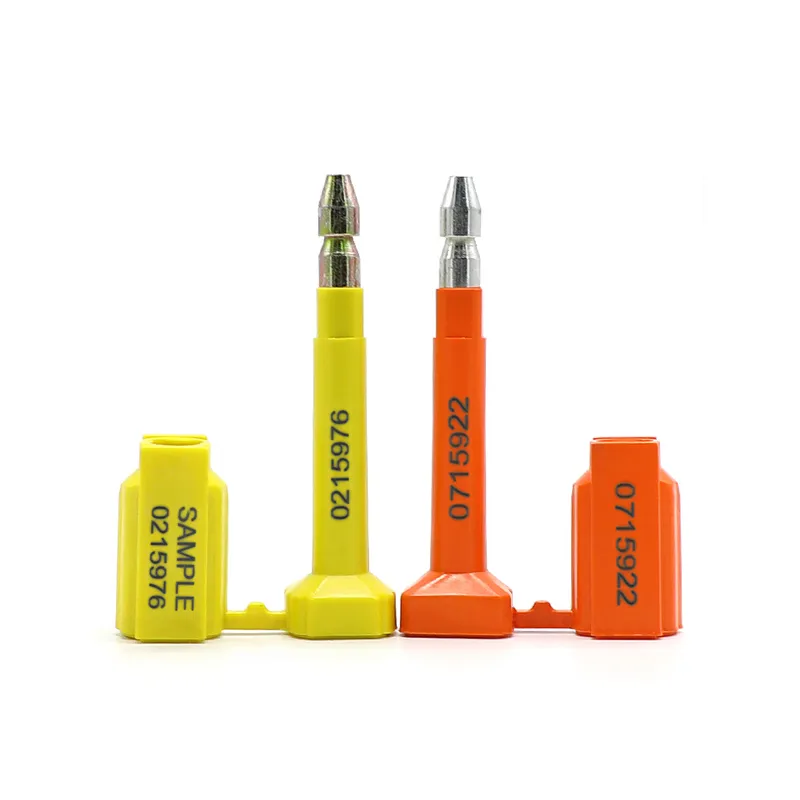
A bolt seal is a fixed-length, high-security seal designed for one-time use on shipping containers, truck trailers, and rail cars. It consists of a steel bolt (the pin) and a locking body. The pin inserts into the body, and an internal locking ring or ball bearings permanently engage, creating a seal that must be cut with bolt cutters to remove. Standard lengths range from about 3 to 5 inches, and the pin diameter is typically 8 mm to 9 mm. The locking body is often chrome-plated or zinc-plated steel for corrosion resistance. Bolt seals are ISO 17712 certified “H” class when tested for tensile strength of at least 1,500 kg and shear strength of 1,000 kg. In container shipping, the bolt seal is applied through the door hasp of an ISO container, and its unique serial number is recorded on shipping documentation. Because the seal must be physically destroyed to open, any tampering is immediately visible. I’ve seen thousands of these seals leave our factory, and a well-made bolt seal offers a straightforward, globally recognized security solution for standard containerized cargo.
What Is a Barrier Seal and Where Is It Used?
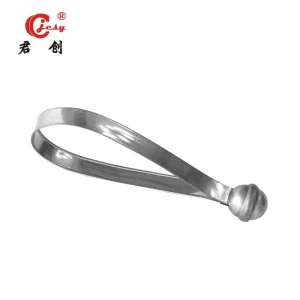
Barrier seals are high-security metal strap seals that wrap around a container’s locking bars, effectively covering the door mechanism. Unlike bolt seals that fit through a small hasp, a barrier seal creates a metal band across the entire closure point, making it impossible to open the doors without first cutting the seal. These seals are often constructed from galvanized steel strips with a heavy-duty locking housing. They are used in applications requiring an extra layer of physical obstruction, such as cross-border trucking, military logistics, cash-in-transit, and high-value cargo shipments. Because barrier seals are larger and more visible, they also serve as a strong visual deterrent. I’ve observed that customers handling high-risk routes often prefer barrier seals because the seal itself draws immediate attention to any tampering attempt. Barrier seals can meet ISO 17712 if they achieve the required strength metrics, though their primary advantage is the comprehensive blocking mechanic rather than just lock-and-pin integrity.
What Are the Key Differences Between Barrier and Bolt Seals?
The table below breaks down the core differences that matter most to procurement teams.
| Feature | Bolt Seal | Barrier Seal |
|---|---|---|
| Locking mechanism | Internal pin lock inside hasp | Metal strap wraps around locking bars |
| Installation point | Container door hasp | Full door lock bar assembly |
| Material | Hardened steel pin, zinc/chrome body | Galvanized steel strap, alloy housing |
| Tamper evidence | Pin cut or locking body fracture | Cut strap, bent housing, or broken lock |
| Visibility | Moderate | High — large strap is very visible |
| ISO 17712 compliance | Common, easily achieved | Possible if strength tested |
| Tool requirement for removal | Bolt cutter | Bolt cutter or heavy-duty cutting tool |
| Best for | Standard container, rail, truck (single door hasp) | High-value cargo, cross-border, security-critical applications |
Beyond these specs, real-world experience shows that the locking body tolerance in bolt seals can affect pull resistance. If the internal ring is not machined tightly, a poorly made seal creates an opportunity for twisting attacks that may not leave obvious marks, though cutting is still the primary removal method. For barrier seals, the welding quality of the strap to the housing often determines if the seal withstands brute force without breaking at the joint. These are the details a factory inspection should catch.
If your program involves high-risk transit lanes or requires seals that resist not just opportunistic theft but targeted cargo theft rings, confirming the actual tensile failure points and tamper evidence mechanisms beyond the certificate is a critical step. We regularly share detailed test reports with logistics partners so they can make that assessment before finalizing a seal specification. Reach out to our engineering team at [email protected] with your requirements.
What Manufacturing Quality Factors Should Buyers Verify?
When comparing bolt seal and barrier seal suppliers, the manufacturing origin and quality control system matter as much as the seal type. In over 15 years of production, I’ve learned that seals that look identical on a catalog page can perform very differently. Here are the specific areas to audit:
- Raw material sourcing: Bolt seal pins must be heat-treated steel with consistent hardness; poor-quality pins can be cut more easily. Barrier seal straps need uniform galvanizing to prevent rust-out in humid or marine conditions.
- Machining precision for bolt seals: The locking ring inside the bolt seal body must engage with zero backlash. A loosely fitted ring creates a twisting attack opportunity that, while still requiring effort, may not leave obvious marks.
- Strap attachment strength for barrier seals: The point where the metal strap is fixed to the locking housing is a common failure point. A proper factory uses resistance welding with load tests on every batch.
- Marking and serialization: Laser-engraved or deeply stamped serial numbers that cannot be removed without grinding are essential for traceability. Superficial ink printing wears off.
- Production consistency: Ask for batch test reports showing tensile strength distribution, not just a maximum number. A wide variability suggests process control problems.
Checking these factors during a factory audit or reviewing production documentation keeps you from accepting seals that pass a catalog spec but fail in the field.
When Should You Choose a Barrier Seal Over a Bolt Seal?
The decision hinges on three main factors: the cargo value, the geographic risk, and the handling environment. Bolt seals are the standard for most ISO container shipments because they are simple, universally accepted by customs, and cost-effective. However, when shipping high-value electronics, pharmaceuticals, or cargo moving through high-theft corridors, a barrier seal adds a physical obstruction that makes forced entry slower and noisier. A barrier seal is also preferable if the container’s hasp is worn or if the door design makes a standard bolt seal difficult to install. In practice, I’ve seen logistics operators use both: a bolt seal on the hasp as the primary seal and a barrier seal as an additional deterrent for the highest-risk segments. This layered approach increases tamper detection without complicating the customs clearance process.
Securing cargo with the right seal is a decision that directly affects supply chain integrity. Whether you need ISO 17712 bolt seals or barrier seals, the seal’s performance hinges on manufacturing quality as much as design. At Shandong Junchuang Lock Industrial Co., Ltd., we manufacture security seals with strict process controls, and we supply pre-production sampling, batch testing documentation, and technical specification guidance. Share your cargo security requirements and volume with us, and we will recommend the seal type and specification that matches your operational risk. Contact us by email at [email protected] or by phone/WhatsApp at +86 13853189290.
Common Questions from Seal Buyers
Can a barrier seal replace a bolt seal for ISO shipping containers?
A barrier seal cannot directly replace a bolt seal in the same hasp hole because it wraps around the locking bar assembly. However, many shipping lines accept barrier seals as an additional or even primary seal if properly installed and meeting strength requirements. Always confirm acceptance with your carrier.
Are bolt seals always ISO 17712 certified?
It is a common misconception that any bolt seal with a shiny pin is automatically ISO 17712 compliant. In reality, certification requires lab testing of tensile and shear strength, plus tamper evidence evaluation. As a buyer, you should request a valid ISO 17712 certificate and verify the testing lab’s accreditation. In our production, we test each batch for compliance before shipment.
Which seal is more tamper-evident: bolt or barrier?
From our factory testing experience, barrier seals tend to be more visibly tamper-evident because their larger size makes damage harder to miss. A compromised barrier seal is hard to overlook, while a bolt seal may show subtle tool marks that a rushed driver could fail to notice. Training staff to inspect seals is as important as the seal type chosen.
How much more does a barrier seal cost compared to a bolt seal?
It depends on the order volume and customization, but generally a barrier seal costs more than a bolt seal due to material volume and manufacturing complexity. On average, a high-security bolt seal in bulk might range from roughly $0.15 to $0.40 per unit, while a barrier seal can range from $0.50 to $1.50 depending on strap length and coating. These figures are approximate; actual pricing depends on order quantity and custom features. For an exact quote tailored to your needs, email us your specifications.
If you’re interested, check out these related articles:
Meter Lead Seals: Essential Security for Utility and Measurement Devices – Junchuang Lock
Cable Tie Tensile Strength: Engineering Secure Fastening – Junchuang Lock
Bolt Seal OEM Manufacturing Process: A Technical Deep Dive – Junchuang Lock