
A plastic padlock seal is only as reliable as the material and molding process behind it. Most sourcing guides describe what these seals do—secure truck doors, bags, and containers—but they rarely address the manufacturing variables that determine whether a seal will hold or fail in the field. Over a decade and a half on the production floor, I have seen how the choice of polypropylene grade, the design of the locking jaw, and the consistency of the injection molding cycle separate a dependable seal from one that opens with a twist. This article explains what goes into a well-made plastic padlock seal from a manufacturing perspective, so procurement teams and logistics operators know what to ask before they order.
Plastic Padlock Seal Design: Material and Locking Mechanism
A plastic padlock seal consists of two main parts: a shackle that passes through a hasp or latch, and a locking body that captures the shackle end. The entire assembly is a one-piece injection-molded polypropylene component in most designs. That simplicity is its strength, because there are no assembly pins or metal springs that can be defeated. The shackle is molded with a tapered barb, and the locking body contains a matching internal catch. When the shackle is pushed through the body opening, the barb snaps past the catch and cannot be withdrawn without destroying the seal.
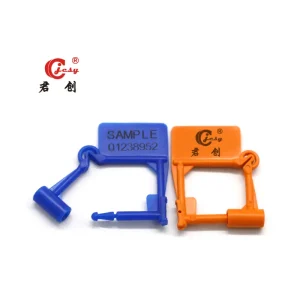
The performance of this simple mechanism depends on two material properties: flexural modulus and impact strength. Polypropylene is chosen because it provides a stiff enough shackle to resist casual pulling while retaining enough flexibility to not snap at the gate during demolding. In our production runs, we specify polypropylene with a flexural modulus above 1200 MPa and a notched Izod impact strength above 5 kJ/m² at room temperature. Lower grades will produce a shackle that bends too easily or a locking body that cracks at the hinge point when the seal is installed. The barb geometry also matters: the angle of the locking ramp must permit smooth insertion but the back angle must lock firmly. Too steep a back angle and the barb snaps off during pull testing; too shallow and the seal can be wiggled open. Our tooling maintains a back angle of 85 degrees with a tolerance of half a degree, and we verify it with a optical comparator at the start of every production shift.
How Manufacturing Precision Affects Tamper Evidence
Tamper evidence on a plastic padlock seal is not an added feature—it is a direct consequence of the locking mechanism design and the consistency of the molding process. When the seal is intact, the shackle is seated flush inside the body. Any attempt to pull the shackle out visibly deforms or fractures the locking body. That fracture is engineered. The internal catch is designed as a stress concentrator; once the shackle is seated, pulling force concentrates at the base of the catch and tears through the surrounding material. The result is a broken seal that cannot be reassembled without visible signs.
In production, two process variables control the repeatability of that fracture behavior: melt temperature and hold pressure during injection. If the melt is too cool, the polymer does not fully pack the mold cavity, leaving internal voids around the catch. A void means the catch can deform inward without tearing the outer body—reducing the tamper evidence to zero. We run our molding machines with barrel zones between 200 and 230 degrees Celsius and hold pressures that maintain cavity pressure above 50 MPa during packing. Every cavity in the multi-cavity mold must fill identically, or the seals from one cavity will behave differently from another. Short shots, flash, and sink marks are not just cosmetic defects on a security seal; they are functional failures. A sink mark near the hinge area means thinner cross-section, which will snap under lower pull force than the design intends.
We test samples from each cavity on a pull tester every four hours during a shift. The target break force for a standard plastic padlock seal is between 12 and 18 kilograms. If a sample from any cavity falls outside that range, we stop production and inspect the tool. Over the years, I have found that the most common root cause is worn ejector pins causing micro-cracks in the gate area, which propagate during pull testing. A ten-minute pin replacement prevents a whole shift of borderline seals from reaching the customer.
Evaluating Plastic Padlock Seal Quality Before You Buy
Procurement teams buying plastic padlock seals in bulk often rely on a sample photograph and a specification sheet. That is a start, but it misses the two things that matter most: production consistency and break-force repeatability. When we receive sample requests from importers or logistics companies, we send seals from a running production lot, not from a hand-picked tray. The reason is simple: if the sample does not represent what the customer will receive in a 100,000-piece order, the sample is useless. I encourage buyers to request exactly that—random samples from a live production batch.
A handful of simple physical tests reveal more than a data sheet. Pull the shackle until it breaks. If the break force varies by more than 20 percent across five samples, the molding process is either unstable or the tool has worn unevenly across cavities. Look at the gate vestige on the locking body. A sharp, high vestige means the gate trimmer is dull or misaligned—that sharp point can scratch a worker’s hand during installation and create a weak point where the shackle can be snapped by hand. The locking body should be uniformly colored, not marbled or streaked. Marbling indicates either insufficient mixing of colorant or regrind material mixed into virgin resin, both of which reduce impact strength.
Serial numbers and barcodes are another quality indicator. If the printing is smeared, off-register, or rubbing off fresh out of the bag, the ink curing process is inconsistent. We cure laser-printed markings at an elevated temperature for a fixed dwell time after printing; ink that is not properly bonded will degrade under sunlight and handling, making the seal’s traceability chain unreliable. A plastic padlock seal without a legible serial number is just a piece of plastic. The whole purpose is lost.
Customization Options That Improve Traceability and Logistics Control
A standard plastic padlock seal with sequential numbering provides basic traceability: the number on the seal matches the number on the consignment note. However, many logistics operations need more than that. Customization extends to corporate logos, barcodes, QR codes, multiple color options, and even custom-shaped shackle tips for specific hasp dimensions. Each addition requires the factory to integrate a secondary process after molding, and that process affects delivery lead times and unit cost.
From a manufacturing standpoint, the most robust customization is laser-etched marking done inline. After the seal exits the mold and cools, a laser head etches the number or barcode into the surface. The mark becomes part of the material, not a layer on top. Ink-based hot-stamping is also common and works well on polypropylene when the foil and temperature are tested for adhesion. However, I have seen plenty of stamping failures where the foil rubs off with a thumb swipe. That happens when the stamping head temperature drops between cycles, a problem that automated temperature controllers easily prevent—but only if the factory has invested in them.
Color coding is another practical customization. Different colors allow warehouse teams to assign seals to different routes, customers, or security levels without stopping to read a number. We mold seals in red, blue, yellow, green, white, and orange as standard, with custom color matching available for larger runs. The color is masterbatch blended at the hopper, so the shade remains consistent across the full production lot.
For importers placing their first bulk order, I always recommend starting with a pre-production sample that includes your logo and the numbering format you intend to use. This sample run reveals whether the laser or stamping setup produces legible, durable markings on your specific seal design. It takes about a week, costs a small tooling fee, and prevents a container of seals arriving with smudged codes.
Working with a Plastic Padlock Seal Manufacturer for Long-Term Supply
Plastic padlock seals are a repeat-purchase item for most users. Trucking fleets, logistics providers, and cash-in-transit services consume thousands per month. That makes the manufacturer relationship more important than the unit price of a single order. A factory that understands your usage pattern can maintain buffer stock, pre-serialize your numbers, and ship within your reorder window without you carrying excess inventory.
I have found that the partnerships that last longest are built on two things: the manufacturer’s willingness to share process data and their responsiveness when something goes wrong. A factory should be able to provide mill certificates for the resin used in your order, cavity pressure monitoring records, and pull-test data from the production lot—not because most buyers ask for it, but because it demonstrates that the process is under control. If a quality issue does arise, the conversation should move from diagnosis to corrective action within days, not weeks.
Lead time for standard plastic padlock seals from a Chinese factory with in-house molding capability is typically two to three weeks for quantities under 200,000 pieces. Customized orders with logo and barcode add about a week for pre-production sampling and approval. Shipping by air freight cuts delivery to a few days, while sea freight takes longer but makes economic sense for orders above a few hundred thousand pieces. I advise buyers to factor in a four-week safety buffer for the first shipment and to align reorder points with that lead time plus their consumption rate.
When you find a manufacturer that consistently hits your break-force specifications, delivers on time, and communicates openly, stay with them. Switching to a cheaper supplier almost always introduces a period of quality variation and logistics friction that costs more than the per-unit savings.
Common Questions About Plastic Padlock Seal Sourcing
Are plastic padlock seals reusable?
No, plastic padlock seals are single-use devices by design. The locking mechanism permanently deforms the shackle barb or the internal catch, making the seal impossible to open without destroying it. Reuse would eliminate the tamper-evident function. For applications that require frequent access, an adjustable cable seal or a metal padlock seal with a reusable locking body is a better choice. If your operation needs a balance between security and reusability, send your door and hasp specifications to [email protected] and we can recommend a seal type that fits.
What is the difference between a plastic padlock seal and a regular padlock?
A plastic padlock seal is not a lock; it is a tamper-evident device. A regular padlock resists entry, but a plastic padlock seal’s job is to provide visible proof if entry has occurred. The plastic shackle snaps at a known force—typically around 15 kilograms—so the seal cannot be used where the hasp is under load. The seal’s purpose is in the audit trail: a broken or missing seal tells the consignee to inspect the cargo before accepting it.
How do I verify the quality of a plastic padlock seal sample?
Beyond the pull test and visual inspection covered above, check the gate mark, the color uniformity, and the batch-to-batch consistency if you have multiple samples from different production dates. Heat a seal to around 60 degrees Celsius (a hot car in summer) and pull it again; the break force should not drop more than 10 percent. If it softens noticeably, the resin contains too much regrind or a lower-grade polymer. This is a quick field test that reveals material shortcuts a manufacturer may hope you never notice.
Can I order plastic padlock seals with my company’s logo and numbering sequence?
Yes, that is a standard customization. Laser etching and hot stamping both support logos, sequential numbers, and barcodes. The key is to confirm with the factory how the numbering is managed across multiple orders. A well-organized manufacturer tracks your last issued number so the next shipment picks up where the previous one ended. This continuity is critical for traceability systems. For a pre-production sample with your specific logo and numbering format, reach out at [email protected] or call +86 13853189290, and we will walk through the process and timeline.
If you’re interested, check out these related articles:
Preserving Security Seal Integrity: A Storage Best Practices Guide – Junchuang Lock
China Security Seal Manufacturers: Strategic Selection Guide – Junchuang Lock
Wholesale Cable Seals for Logistics: Enhancing Supply Chain Security – Junchuang Lock
Selecting a Security Seal Manufacturer for Supply Chain Integrity – Junchuang Lock
Plastic vs Metal Seals: Security, Durability, Cost Analysis – Junchuang Lock