
Metal strap seal strength is often reduced to a single tensile rating printed on a packaging label, but our production floor reveals a more complex reality: the material composition, manufacturing tolerances, and finishing processes together determine how a seal performs under field stress. We have seen seals with identical catalog ratings fail differently in side-load scenarios because the steel gauge, plating thickness, or rivet assembly step was inconsistent. This article examines the materials and production factors that dictate real-world metal strap seal performance, so procurement teams can evaluate seals beyond the datasheet.
What Determines Metal Strap Seal Strength
The quoted breaking strength of a metal strap seal usually comes from a straight-pull tensile test. While that number matters, a seal’s actual security comes from multiple failure modes—prying, twisting, cutting, and repeated shock loading—that are not captured by a single static test. A seal rated at 3,000 N may hold a static load but break when a crowbar is leveraged under the strap loop, or fail at 1,500 N if the strap is being twisted while pulled because the force concentrates unevenly.
We measure strength not only in the lab but through field-condition simulations that replicate how a forklift or careless handling can impose lateral force on a locked seal. In our experience, a seal that passes a 2,000 N straight-pull but shows hairline cracks at the rivet hole after 500 N of side-loading is not suitable for high-violence transport lanes. This nuance is invisible in a catalog sheet.
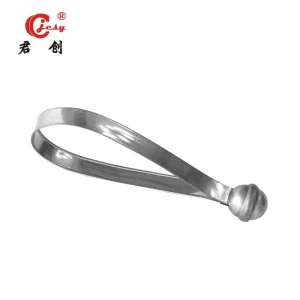
Materials and Manufacturing: The Dual Foundation of Seal Strength
Most metal strap seals use cold-rolled steel, chosen for its balance of strength, ductility, and cost. The base steel gauge typically ranges from 0.4 mm to 1.0 mm, directly affecting the force required to cut or tear through the seal body. Thicker steel raises costs but provides a non-linear gain in security—0.6 mm to 0.8 mm might add 20% more steel but almost double the tool marks required to sever the strap.
Plating is the difference between a seal that survives six months in a coastal shipping route and one that rusts through in three months. Zinc plating is the standard; hot-dip galvanizing adds thickness and sacrificial protection for high-humidity or salt-spray environments. Stainless steel variants exist but are significantly more expensive and harder to stamp, so they are rarely used outside niche military or food-grade applications.
| Material Factor | Cold-Rolled Steel (Zinc Plated) | Hot-Dip Galvanized Steel | Stainless Steel (304) |
|---|---|---|---|
| Typical tensile strength | 350–500 MPa | 350–500 MPa (base) | 515–620 MPa |
| Corrosion resistance | Moderate (coastal = 6–12 months) | High (salt spray >500 hours) | Very high (marine grade) |
| Relative cost | 1x | 1.3–1.5x | 3–4x |
| Common thickness | 0.5–0.8 mm | 0.6–1.0 mm | 0.4–0.6 mm |
Manufacturing tolerances matter as much as material specs. A steel strip that is 0.78 mm instead of the nominal 0.80 mm may pass thickness checks but introduces play in the locking mechanism, reducing the effective holding force by 10–15%. We inspect each incoming coil with a tolerance of ±0.02 mm, which is tighter than many commercial-grade seal factories apply.
The single most overlooked variable in metal strap seal performance is stamping consistency. Each strap hole must align with the locking tab with a clearance that is precise: too tight and the strap cannot feed during installation; too loose and the tab contacts only partially, reducing holding force. Our tooling is inspected after every 20,000 cycles and replaced when wear exceeds 0.03 mm, because a worn punch creates progressively larger holes and lowers the effective interlock.
Rivet quality also separates reliable seals from uncertain ones. A poorly set rivet can create a stress riser that snaps under side-load. Our rivets are made from hardened steel and set with automated pressure-verified stations. We have seen competitors’ seals where the rivet head is flattened by hand, leaving micro-cracks inside the assembly that propagate after a few thousand kilometers of truck vibration.
Real-World Performance Under Environmental Stress
Cargo moves through deserts, frozen highways, and salt-laden docks. A metal strap seal rated for 2,500 N at 20°C may lose 20% of its clamping retention at -20°C because the steel contracts infinitesimally, loosening the lock. Combined with vibration over a 2,000‑kilometer truck route, a loose seal can work itself free without being cut.
Corrosion is the most predictable failure and the easiest to prevent. We have examined failed seals returned from West African coastal routes where standard zinc plating had disappeared entirely, leaving the steel lock body so corroded that the strap slid out without tool marks. For those corridors, specifying hot-dip galvanized or even a secondary clear lacquer coat over zinc can extend field life into the acceptable range.
Comparing Metal Strap Seals with Other High-Security Seals
Metal strap seals offer a balance of moderate strength and low unit cost that makes them practical for high-volume applications like trailer doors or railcar hatches. Compared to bolt seals, which typically exceed 15,000 N in breaking strength, a metal strap seal operates in the 2,000–5,000 N range, but it can be applied and removed more quickly and costs a fraction—often $0.30–$0.80 per seal versus $2–$5 for a bolt seal. Cable seals, meanwhile, have a flexible cable that absorbs shock better but offer lower cut resistance than a steel strap.
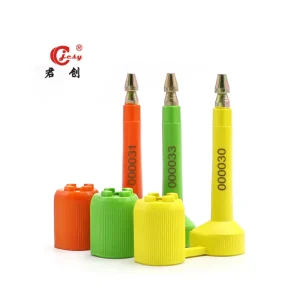
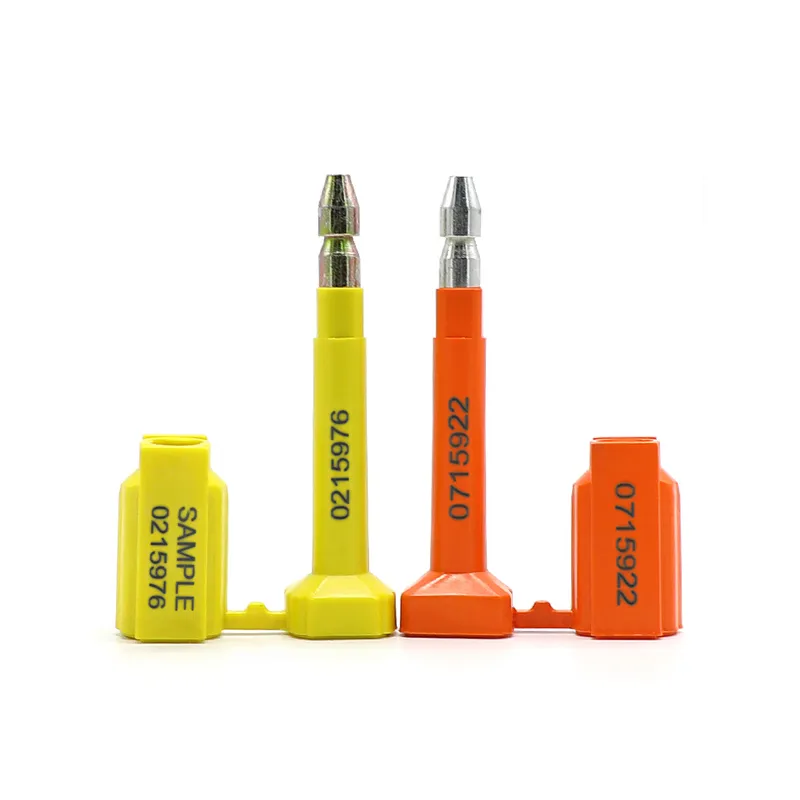
If your route requires ISO 17712 high-security certification, a metal strap seal alone may not meet the 18 kN tensile requirement; you will likely need a bolt seal or a high-tensile cable seal. However, for tamper-evidence and deterrence in intermodal truck cargo or domestic freight, a properly manufactured metal strap seal with a thick strap and robust locking mechanism provides a strong balance.
If transshipment occurs in multiple climate zones, it is worth evaluating the seal material against the entire route, not just the destination. Our team at Junchuang Lock Industry can provide material verification against your specific routing—reach us at [email protected].
Selecting the Right Metal Strap Seal for Your Application
When we speak with procurement managers, we often see them focus on price per seal while underestimating the cost of a single broken seal leading to cargo tampering. The decision tree should start with the threat level: Is the seal a primary barrier or a secondary tamper-evidence device? Then add environmental factors: temperature range, humidity, salt exposure. Finally, consider installation speed: a seal that is too stiff to thread quickly will slow down distribution center operations.
We produce metal strap seals with material options covering plain zinc, hot-dip galvanized, and even custom plating work. Sending us your route profile and seal usage volume lets us recommend a specific material thickness and treatment that matches your risk without overspending. For bulk orders, we can provide lot-specific tensile test reports.
We manufacture metal strap seals with a focus on controlled material sourcing and verified production steps. Each production batch undergoes tensile and salt-spray testing, and we can ship small pre-production samples for your own field evaluation. To discuss your strength requirements or obtain a quotation, contact us at [email protected] or call +86 13853189290.
Common Questions About Metal Strap Seal Strength and Materials
Are metal strap seals reusable?
No. A metal strap seal is a one-time locking device. Once the strap is pulled tight and locked, the only way to remove it is to cut it, which destroys the seal. This ensures clear tamper evidence. Using a seal more than once creates undetectable damage that compromises security.
Which material holds up best in coastal areas?
It depends on the exposure duration. For short-term transits under three months, zinc-plated cold-rolled steel is usually sufficient, particularly if a clear lacquer overcoat is applied. For long-term storage or repeated voyages through humid ports, hot-dip galvanized steel shows significantly less corrosion, and in extreme cases, stainless steel, though expensive, may be the only viable option if seal integrity is critical for weeks at sea.
Does a higher tensile rating always mean a better seal?
Not necessarily. A seal rated at 5,000 N high-tensile steel that is poorly manufactured with misaligned locking tabs can fail at far lower force under twisting than a well-made 3,000 N seal. We often tell buyers to ask for a production sample and test it themselves: pull, pry, and twist it. The datasheet is a starting point, not the final answer.
What is the difference between metal strap seals and bolt seals in strength?
Bolt seals are significantly stronger, with ISO 17712 ratings exceeding 15,000 N, while metal strap seals normally fall between 2,000 and 5,000 N. The trade-off is cost and application speed. Metal strap seals install without tools and cost much less; bolt seals require a bolt cutter for removal and are used for cross-border container shipments where security is paramount. For domestic trailer seals, a heavy-gauge metal strap seal often provides ample deterrence.
Can we get custom markings on metal strap seals?
Yes, most manufacturers, including us, can hot-stamp or laser-mark serial numbers, barcodes, or company logos onto the metal surface. Custom markings do not affect strength but add traceability. However, deep stamping on thinner gauge steel may introduce micro-fractures, so we usually recommend matching the stamping depth to the material thickness. If traceability and compliance documentation are required for your program, send your part number and quantity to [email protected], and we will confirm the marking compatibility.
If you’re interested, check out these related articles:
Bolt Seal Quality Inspection: Safeguarding Cargo & Compliance – Junchuang Lock
UV Resistant Security Seals: Protecting Assets from Sun Degradation – Junchuang Lock