
Managing cables outdoors has taught me that the environment rarely cooperates. Sunlight breaks down materials faster than most people expect, and what starts as a minor oversight—using the wrong cable tie—can snowball into system failures and unplanned repair costs. After working through enough of these situations, the value of UV resistant cable ties becomes obvious. They’re not a premium upgrade; they’re the baseline for any outdoor setup that needs to last.
Why UV Exposure Destroys Standard Cable Ties
Ultraviolet radiation does real damage to polymers. When standard plastic cable ties sit in direct sunlight, the UV energy breaks apart the molecular chains that give the material its strength. The result is a predictable sequence: the surface becomes chalky, the material turns brittle, and eventually the tie snaps under loads it once handled easily.
The failure pattern matters here. It’s rarely one tie that goes. UV degradation affects every exposed tie in an installation at roughly the same rate. In large-scale outdoor projects—solar arrays, telecom infrastructure, outdoor industrial equipment—this means widespread failures can hit within the same maintenance window. The repair costs multiply quickly, and the downtime affects operations.
UV resistant cable ties address this directly. The material formulations include stabilizers that absorb or deflect UV radiation before it can degrade the polymer structure. This isn’t about making ties slightly better; it’s about extending functional lifespan from months to years.
Material Science Behind UV Resistant Cable Ties
The durability gap between materials is significant. Each polymer handles UV exposure differently, and the protection mechanisms vary. Knowing what’s actually in the tie—and why it works—helps match products to specific conditions.
| Material Type | Primary UV Protection Mechanism | Key Advantages | Typical Operating Temperature Range | Chemical Resistance |
|---|---|---|---|---|
| Nylon 6/6 (w/ Carbon Black) | UV absorption, radical scavenging | High tensile strength, cost-effective | -40°C to 85°C | Good against oils, greases |
| Acetal (POM) | Inherent polymer stability | Excellent weatherability, low friction | -40°C to 100°C | Good against fuels, solvents |
| Polypropylene (Specialty) | UV stabilization additives | Lightweight, good fatigue resistance | -20°C to 90°C | Excellent against acids, bases |
Nylon 6/6 with Carbon Black
This combination dominates outdoor applications for good reason. The carbon black—typically 2-4% by weight—does the heavy lifting. It absorbs UV radiation and neutralizes the free radicals that would otherwise attack the nylon polymer chains.
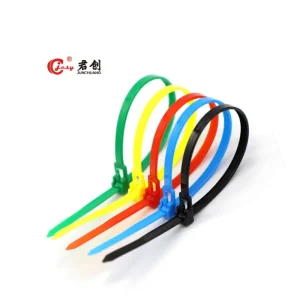
The Nylon Cable Tie with proper carbon black loading maintains tensile strength even after years of direct sun exposure. The material stays flexible rather than becoming brittle. For most outdoor cable management needs, this is the reliable, cost-effective choice.
Acetal and Specialty Polypropylenes
Some environments demand more than standard nylon can deliver. Acetal cable ties handle chemical exposure better—useful in marine settings where salt spray is constant, or in industrial facilities where fuel and solvent contact is possible. The polymer itself resists UV degradation without relying as heavily on additives.
Specialty polypropylenes fill a different niche. They’re lighter, handle fatigue loading well, and resist acids and bases that would attack nylon. The UV resistance comes from stabilizer additives rather than inherent polymer properties, so quality varies more between manufacturers.
Selecting the Right UV Resistant Cable Tie
Material choice is only part of the equation. The physical specifications need to match the actual installation conditions, and cutting corners on this step leads to premature failures.
Sizing and Strength Requirements
Start with the bundle diameter. The tie needs enough length to wrap the bundle with room for the locking mechanism to engage properly—not so much excess that the tail becomes a snag hazard.
Tensile strength selection requires thinking about worst-case loads, not typical conditions. Wind creates dynamic forces. Vibration from nearby equipment adds cyclic stress. Temperature swings cause materials to expand and contract. The Cable Tie Wholesale rating should exceed your calculated maximum load by a comfortable margin. Ties that barely meet the requirement under ideal conditions will fail when conditions aren’t ideal.
Certifications That Matter
For professional installations, certifications provide verification that the product performs as claimed. UL recognition confirms the tie meets safety standards for electrical applications. RoHS compliance indicates restricted substances have been eliminated—important for projects with environmental requirements. REACH compliance covers chemical safety regulations in European markets.
UV testing standards, particularly ASTM G154, define how accelerated weathering tests are conducted. Products tested to these standards have documented performance data rather than vague durability claims.
Where UV Resistant Cable Ties Prove Essential
The applications span industries, but the common thread is outdoor exposure combined with reliability requirements.
Solar installations put cable ties under constant UV bombardment. The wiring runs across panel arrays where shade is minimal and replacement access is difficult. Telecommunications infrastructure faces similar challenges—cables routed along poles and towers need fasteners that won’t fail between maintenance cycles.
Automotive applications include under-hood wiring where heat and UV combine, plus exterior routing on commercial vehicles. Marine environments add salt spray to the UV and moisture exposure. Agricultural equipment operates in open fields with no shelter from sun or weather.
Installation Practices That Extend Lifespan
Even the best UV resistant cable ties underperform when installed poorly. A few practices make a measurable difference:
Clean the mounting surfaces before installation. Dirt and oil reduce grip and can trap moisture against the tie surface.
Apply tension correctly. Too loose and the bundle shifts; too tight and you risk damaging cable insulation. A Cable Tie Lock tool provides consistent tension and clean cuts, eliminating the sharp edges that hand-cutting leaves behind.
Route ties away from sharp edges on mounting surfaces. Where contact with edges is unavoidable, protective sleeves prevent abrasion damage.
Schedule periodic inspections. Even UV resistant cable ties eventually degrade. Catching early signs of wear—surface crazing, reduced flexibility—allows planned replacement before failures occur.
Testing Standards and Realistic Lifespan Expectations
Manufacturers use accelerated weathering tests to predict how UV resistant cable ties will perform over time. ASTM G154 is the common reference standard. Test chambers cycle samples through UV exposure, moisture, and temperature variations that simulate years of outdoor conditions in weeks or months.
The correlation between accelerated testing and real-world performance isn’t perfect—actual conditions vary more than lab simulations—but it provides a reasonable basis for comparison between products.
Quality UV resistant cable ties typically deliver 7-10 years of service in moderate climates with direct sun exposure. In less demanding conditions, 15+ years is achievable. Compare this to standard ties that may fail within a single season of outdoor use, and the value proposition becomes clear.
Working with Shandong Junchuang Lock Industrial Co., Ltd.
For cable management solutions built for harsh outdoor conditions, Shandong Junchuang Lock Industrial Co., Ltd. provides industrial-grade sealing and fastening products designed for long-term durability. Contact us at [email protected] or +86 13853189290 to discuss your specific application requirements.
Frequently Asked Questions About UV Resistant Cable Ties
What is the expected lifespan of UV resistant cable ties in direct sunlight?
Quality UV resistant cable ties last 7-10 years under direct sun exposure in most climates, with some installations exceeding 15 years in moderate conditions. The actual lifespan depends on the material formulation—Nylon 6/6 with 2-4% carbon black performs differently than Acetal or specialty polypropylenes—and the intensity of UV exposure at the installation location. Standard ties without UV stabilization often fail within months under the same conditions.
Are all black cable ties UV resistant, or is there a specific designation to look for?
Black color alone doesn’t indicate UV resistance. While carbon black is an effective UV stabilizer, some black ties use colorants that provide no protection. Look for explicit designations: “UV Resistant,” “Outdoor Rated,” or “Weather Resistant.” Check the material specifications for confirmation—Nylon 6/6 with minimum 2% carbon black, or other documented UV-stabilized polymers. Reputable manufacturers provide this information on product datasheets.
How do I choose the correct size and strength of UV resistant cable tie for my application?
Measure the bundle diameter and select a tie length that allows proper engagement of the locking mechanism without excessive tail length. For tensile strength, calculate the maximum load including environmental factors like wind and vibration, then choose a rating that exceeds this value with margin to spare. The goal is a secure hold under worst-case conditions, not just typical operating loads.